Guides
Pricing tire shop services so the margin survives for new owners
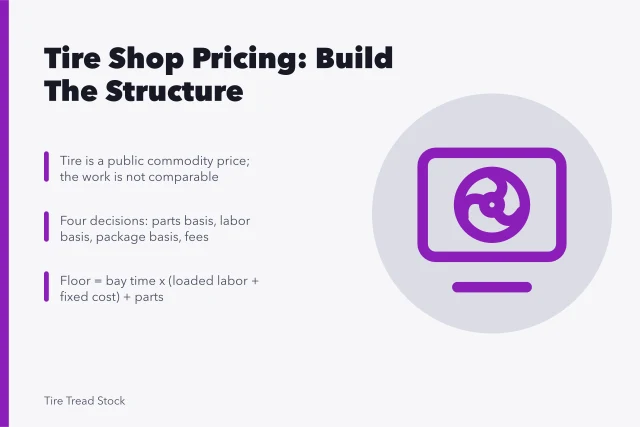
A step-by-step procedure for setting tire shop service prices: measure the bay hour, measure the job, add the parts basis, then test the number.
What to take away
- Setting a price is a procedure, not a judgment. Run it once properly and the whole list falls out.
- Two measurements do most of the workwhat a productive bay hour costs you, and how long each job really takes.
- Productive bay hours are far fewer than open hours. Using open hours is the error that quietly ruins the arithmetic.
- Test every price against a bad day, not a good one, because the bad day is where thin prices fail.
- Fair means the customer can see what they are paying for. It does not mean cheap.
Step 1: count productive bay hours
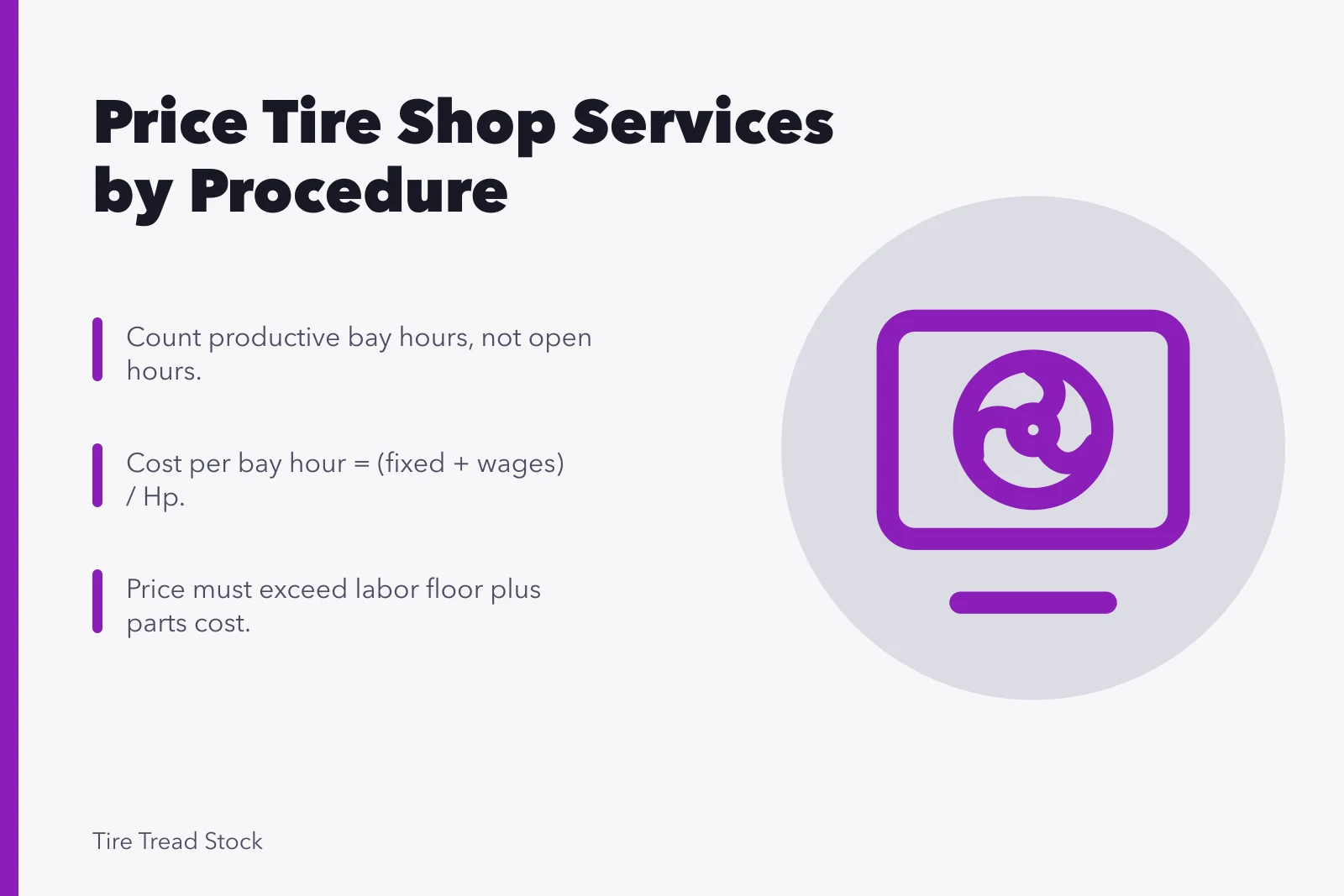
Not open hours. Not scheduled hours. The hours a bay actually has a vehicle on it generating billable work.
Take four typical weeks and count. Subtract the hour nobody booked, the time the technician spent on a comeback, the wait for a special-order tire with the lift occupied, and the morning the machine was down. What is left is the denominator for everything below, and it is usually a good deal smaller than owners expect.
Call it Hp, productive bay hours per month.
Step 2: cost the bay hour
Add up what the shop spends per month that does not vary with the number of jobs: rent, utilities, insurance, software, loan payments, base salaries, waste service, everything on the standing list. Call it F.
Add fully loaded technician cost, meaning pay plus employer costs, for the people producing those hours. Call it W.
Cost per productive bay hour is F plus W, divided by Hp.
That single number is the most useful figure in the business. Every job either covers its share of it or is subsidized by another job. For a defensible starting reference on the wage side, published local data in the Bureau of Labor Statistics occupational tables is a better anchor than a figure overheard from a competitor.
Step 3: measure the job
Time each service you offer, from the moment the vehicle occupies the lift to the moment it leaves it. Include everything that happens: walking to the rack, the sensor that would not relearn, the locking nut nobody could find, the conversation halfway through.
Take a month of real jobs, not a stopwatch demonstration by your best technician. Record the spread as well as the average, because the spread is what breaks your schedule and it belongs in the price of any job you sell at a fixed number.
Step 4: build the number
For a given service, with measured bay time T and direct parts cost P:
- Labor floor is T times the cost per productive bay hour from step 2.
- Parts floor is P.
- Price must exceed the sum of those two, or the job is losing money before anything else happens.
Then add the margin you intend to earn, applied to labor and parts separately, because they behave differently. Parts margin is visible to a customer with a phone. Labor margin is not, and it is where the shop actually earns.
Worked example in named variables
Take a two-tire fitment where measured bay time is T, cost per productive bay hour is C, and the two tires cost P at the door.
Labor floor is T times C. If the shop's parts basis is a tiered markup m for that cost band, the parts side is P times one plus m. The quoted installed price must sit above T times C plus P.
The gap between that floor and your quote pays for everything the floor did not include: the comeback you will occasionally eat, the disposal, the warranty labor, and eventually the owner.
No numbers appear here on purpose. Substituting your own T, C, P and m takes ten minutes and gives you an answer that is true, which no printed benchmark can be.
Step 5: test the price against a bad day
A price that works when the shop is full is not yet a price. Test it three ways.
Step 5: test the price
- At low volume.If Hp falls by a quarter, does the price still cover its share of F? Fixed cost does not shrink with your schedule.
- With the job at its slow end.Use the high end of your measured spread, not the average. Fixed-price work has to survive the version of the job that goes badly.
- With one comeback in ten.Add the rework bay time back in and see whether the price still stands. If it does not, the fix is process rather than price.
Anything that fails all three is a service to reconsider, not a price to raise indefinitely.
Step 6: write it so it can be explained
A price that nobody at the counter can justify becomes a discount within a month.
Step 6: write it
- State what the installed job includes, in customer language.
- Itemize the parts of it a customer would otherwise assume are extra.
- Name the variable items and the stop ruleyou pause, you show them, you quote, they decide.
- Disclose any required fee exactly as your local rules specify.
Whatever appears on a sign, a website or a quote is advertising, and the FTC's guidance on advertising claims for small businesses sets what a claim must be able to support. The short version: a price implying a finished job has to deliver one.
What fair actually means here
Fair does not mean matching the cheapest number in town. It means three things a customer can verify.
What fair actually means
- The same job costs the same for everyone, on the same basis.
- Everything in the total is visible and explainable.
- Nothing is added after the work without a conversation first.
A shop that meets those three can be more expensive than the competition and still be the one people return to, because the surprise is what customers actually resent.
Keeping the numbers current
Rerun steps one through three once a season and after any change to pay, rent, bay count or supplier terms. Keep the working papers: job times, cost breakdowns, comeback counts. These are ordinary business records, and the IRS guidance on what records a business should keep is the reference for holding them in a form that survives.
Two inputs come from elsewhere. Which services are worth carrying at all, ranked by what they contribute per bay hour, is the exercise in the piece on which tire services actually pay. The structural decisions this procedure assumes, the parts basis, the labor basis and how fees are handled, are set out in the pricing and profit guide.
Three other pieces feed the variables. Equipment cost sits inside F and is covered in the equipment and setup guide. Wage cost sits inside W and follows from the hiring and training guide. And volume, which sets Hp, comes from the demand reasoning in the market and expansion guide.
Common questions
What margin should a tire shop aim for?
No answer to that is true across shops, because rent and bay count differ by an order of magnitude. Run the procedure on your own numbers and the question becomes what margin you are actually earning, which is more useful than a target.
Should labor be priced hourly or per job?
Per job is easier for a customer to accept and requires you to have measured T properly. Hourly transfers the risk of a slow job to the customer, which works only where they trust you completely. Most shops do menu pricing on common work and hourly on diagnosis.
How do I price a job I have never done?
Time the first one carefully and quote it as an estimate with a stated stop rule. Do not guess a fixed price on unmeasured work, because the first job of a new type is almost always the slowest one you will ever do.
Is it wrong to charge more than the shop down the road?
No, provided you can say what the difference buys. Customers accept a higher price attached to a clear explanation far more readily than a lower price attached to a vague one.
What if the arithmetic says a popular service loses money?
Believe the arithmetic and look at the inputs before you raise the price. Usually the bay time is longer than the menu assumes, or the rework rate on that service is high. Both are fixable, and both are cheaper to fix than to price around.