Guides
8 things about tire shop pricing and profit worth your time
Tire shop pricing architecture: what a price is built from, four decisions that set the whole structure, and how to answer the online price without discounting.
What to take away
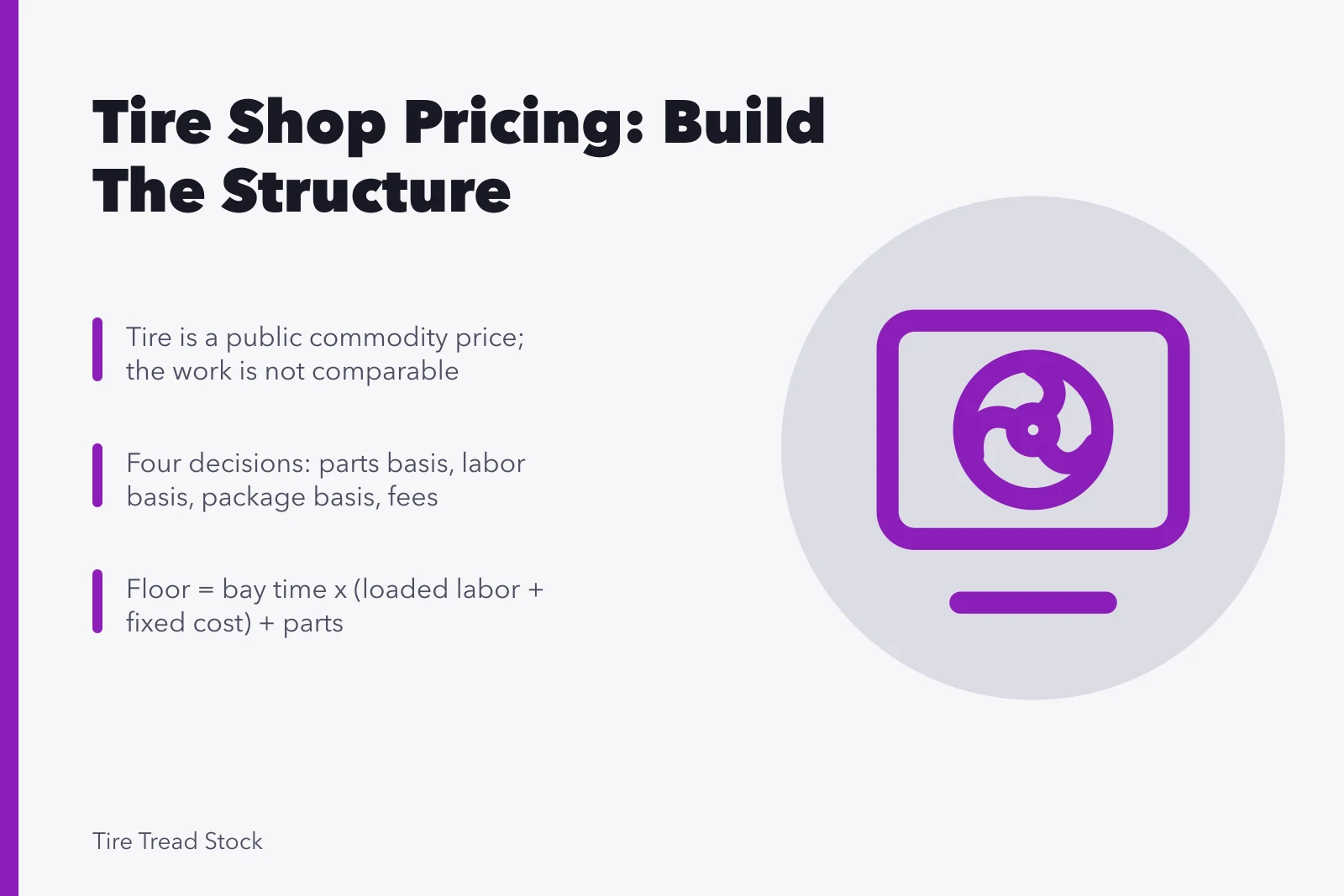
- A tire shop has two prices with different physics. The tire is comparable in seconds on a phone. The work is not.
- Four architectural decisions set your entire price list. Make them deliberately once instead of pricing each job by feel.
- Price the installed job, not the tire. That is the only comparison where you are being judged on what you actually do.
- Fees and shop supplies are disclosed items, not hidden margin, and how they are disclosed is set locally.
- Review the structure when your labor cost, bay count or supplier terms change. Nothing else should move it.
The two halves of a tire shop price
Understand the asymmetry before you set anything.
The tire is a commodity with a public price. A customer standing at your counter can find the identical size and model, from several sellers, in under a minute. Any structure that depends on the customer not looking will fail, and it will fail in front of you.
The work is not comparable that way. Nobody publishes what it takes to mount a low-profile tire on a large-diameter alloy without marking it, relearn a sensor, torque to the manufacturer's specification and stand behind the result. That asymmetry is the whole basis of a durable price list: thin and honest on the goods, properly valued on the work.
The four decisions that set the structure
The options
- Parts basis
- Cost plus a percentage, cost plus a fixed amount, or a tiered matrix by cost band
- Labor basis
- Flat rate per job, hourly, or a published menu price
- Package basis
- Priced as the sum of parts, or priced as a job
- Fee handling
- Inside the quoted number or itemized outside it
What it commits you to
- Parts basis
- A percentage grows with tire price; a fixed amount does not. Tiered sits between and is what most shops end up with
- Labor basis
- Flat rate is easiest for customers; hourly needs measured job times and a customer who trusts you
- Package basis
- A job price is cleaner and requires you to have measured the bay time
- Fee handling
- Set by local rules for anything required, and by your own honesty for everything else
Make all four once, write them down, and price every service from them. The alternative, which is quoting from memory and instinct, produces a list where similar jobs carry different logic and no one at the counter can defend any of it.
Four decisions that set your price structure
Parts basis: cost plus percentage, fixed amount, or tiered matrix
Labor basis: flat rate, hourly, or published menu price
Package basis: sum of parts or priced as a job
What the price must cover before it earns anything
Build the floor from your own numbers rather than a benchmark.
The floor every job must clear
- Lfully loaded labor cost per productive bay hour
- Ofixed cost each productive bay hour must carry
- Tmeasured bay time for the job
- Floor = T x (L + O) + direct parts cost
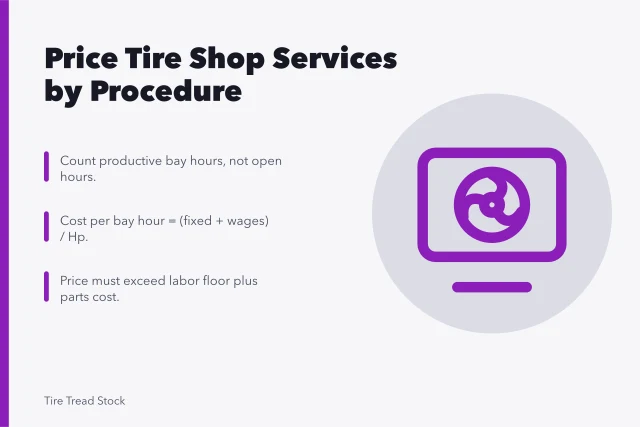
Let L be your fully loaded labor cost per productive bay hour. Let O be the fixed cost each productive bay hour must carry: rent, utilities, insurance, software, the lift loan. That includes costs that arrive with or without a car.
Let T be the measured bay time for the job. The floor is T times the sum of L and O, plus the direct parts cost.
One note on that. Productive bay hours are fewer than open hours, and using open hours understates O badly.
For L, published local wage data from the Bureau of Labor Statistics occupational tables gives you a defensible reference point for your own area, which is a better starting place than a figure a competitor mentioned in passing.
Worked example. Take a shop where a technician costs $30 per productive bay hour fully loaded, including payroll taxes, benefits and the paid hours that are not on a car. Overhead adds $20 per bay hour for rent, utilities, insurance and software.
The shop has to recover $50 for every bay hour it sells. A four-tire mount, balance, sensor relearn and torque job measures 1.2 bay hours, so the labor and overhead floor is $60.
The set costs $560 delivered. The installed floor is $620, and a price of $680 leaves $60 above the floor.
The customer who priced it online this morning
This is now a permanent condition of the trade, and the reflex to discount is the wrong response.
Answering the online price without discounting
- Quote the installed job, not the tire alone
- Itemize so a list beats a single number
- State clearly whether you fit customer-supplied tires
- Do not disparage the comparison the customer made
Whatever you advertise has to hold up, and the FTC's advertising guidance for small businesses sets the expectation: a price that implies a finished job has to deliver a finished job, and required disclosures cannot be buried.
Fees, supplies and disposal
Every removed casing costs money to get rid of, and many jurisdictions require a fee on new tire sales with invoice display rules. That is a compliance issue, not pricing, and the rules are local.
State scrap tire fees typically run from $1 to $5 per new tire, and the amount is published by the state that sets it. The fee has to appear on the invoice in the wording the state requires. Check the current number before you design the invoice, because retrofitting a disclosure is worse than building it in.
Shop supplies are a legitimate cost. Whether they sit inside the labor price or on a separate line is your choice, and the honest test is whether a customer reading the invoice would feel the total was explained. A line they cannot understand costs you more goodwill than it earns in margin.
Tire margin versus labor margin, by the numbers
Three things are true in most tire shops and worth designing around.
Where margin is and is not
Thin margin
- Tire sales
- thin, getting thinner
- Labor
- not the driver
- Attach rate
- second axle, sensor
- Rework
- capacity loss
Real margin
- Tire sales
- not the living
- Labor
- where shops earn
- Attach rate
- moves most money
- Rework
- subtract before judging
- 20 to 30percentTire gross margin typically runs , and no structure will change that. Do not build the business on it.
- 60 to 75percentLabor gross margin typically runs , and that is where a well-run shop earns its living.
- Attach rate, the second axle, the sensor, the alignment check, moves more money than repricing does, and it is not upselling if you are showing the customer something real and letting them decide.Attach rate, the second axle, the sensor, the alignment check, moves more money than repricing does, and it is not upselling if you are showing the customer something real and letting them decide.
The fourth thing is negative. Rework consumes bay time you already sold. A comeback is not a customer service line, it is capacity loss, and it usually clusters on two or three services. Subtract it before you decide a service is profitable.
Keeping the structure honest
Two records make the whole system work, and both are ordinary business records. The IRS guidance on what records a business should keep covers holding them in a form that survives.
Two records that keep pricing honest
- Measured bay minutes per service, actual, for at least a month
- Comeback log by service with bay time cost
- Recompute the floor when job times change
- Review when labor cost, bay count or supplier terms change
Review the structure when your labor cost changes, your bay count changes, or your supplier terms change. Do not review it because a competitor put a sign up, and do not review individual prices monthly. A price list that moves constantly cannot be explained by anyone at the counter.
Three inputs are likely to move in 2027. State minimum wage increases take effect in January in many states, which lifts L for entry-level work.
Scrap tire fees and recycler charges follow local capacity rather than a national number. Tariffs on imported tires can change with trade policy, so ask your supplier for landed cost per tire instead of a list price.
Services, equipment, demand and compliance
Pricing sits downstream of other decisions in the shop. Which services you offer, and what each costs in bay time and skill, comes from the services and packages guide.
The equipment behind those services, and the capital it must repay, is in the equipment and setup guide. Demand, which sets the volume the structure must work at, comes from trade-area counting in the startup and market guide.
Required fee disclosure, invoice format and anything you advertise are governed locally, and the map of who governs what is in the licensing and compliance guide. For the broader framing of how pricing fits alongside financing, staffing and growth decisions, the SBA's business guide covers the sequence most owners work through.
Common questions
Should I publish prices on my website?
Publishing installed job prices for common sizes builds trust and filters out the calls you would rather not take. Publishing tire prices alone invites the comparison you cannot win. If you publish, keep it current, because a stale price is an advertising problem rather than an oversight.
Cost plus a percentage or a fixed markup?
A percentage grows the margin as the tire gets more expensive, which some customers notice on premium sizes. A fixed amount is flat and can leave money on the table. Tiered bands by cost are the usual compromise and are easier to defend at the counter than either extreme.
How should I price customer-supplied tires?
Price the labor properly and be consistent. You lose the parts margin, you keep the bay time, and you carry the same liability for the fitting. Some shops decline the work entirely, which is legitimate as long as it is stated before the customer arrives.
Do I need to match a competitor's price?
Almost never, and matching a number you do not understand is how a shop discovers it has bought a job at a loss. Match the transparency instead: itemize what you do and let the customer see the difference.
How often should the price list change?
When your inputs change, which is usually once or twice a year. A list that moves more often than that cannot be learned by the people who have to explain it.