Guides
Tire shop startup: reading the market first
Tire shop startup planning from the bay outward: fitment math, trade-area reading, changeover season, disposal and claim costs, and a staged opening.
What to take away
- A tire shop sells bay minutes. Rubber is the thing that passes through the bay, not the thing the shop is short of.
- Fitment is unforgiving, so the size you did not stock is a lost sale on a car already on the lift, and the size you overstocked is money sitting on a rack.
- The trade area sets the size list before you do. Count what actually drives past, not what you would enjoy selling.
- Two or three changeover weeks a year carry a disproportionate share of the volume, and they punish a shop that staffed for the average week.
- Costs that arrive without an invoice, disposal, comebacks, road hazard claims, warranty adjustments, decide whether a busy shop is a paid shop.
The bay is the constraint, not the parking lot
Count the productive minutes you can sell in a week. A bay with a lift, a mounting machine, a balancer and one competent technician produces a finite number of mounted and balanced wheels per day, and no amount of inventory raises that number. Everything else in the business exists to keep that bay loaded with work that pays.
This reframes most opening decisions. A second lift is capacity, not an expense.
A tech who can pull a set, mount, balance and torque without a supervisor is not a cost. They are throughput. A phone that rings unanswered during the busiest hour is not a marketing problem. It is a bay running empty while the appointment is booked somewhere else.
It also explains the failure mode that catches new owners. They budget carefully for equipment and inventory, then discover that the limiting number was never dollars. It was the number of wheels one person can turn between opening and close, and how many of those minutes went to jobs nobody paid for.
Sizing the SKU problem before you sign a lease
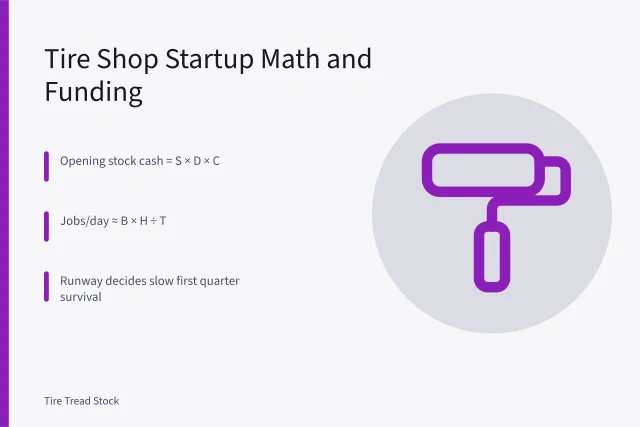
Write this out before the lease, not after. Let S be the number of distinct sizes you intend to stock, and D the depth you hold in each. On-hand units are roughly S times D. Rack space, working capital and the odds of having the right tire when a car is on the lift all move with that product.
The two failure directions are not symmetrical.
Sizing the SKU problem
What it looks like on a good day
- Narrow S, deep D
- Fast turns on the sizes you chose
- Wide S, shallow D
- You can quote almost anything
- Wide S, deep D
- You almost never say no
- Narrow S, shallow D
- Very little cash tied up
What it costs you
- Narrow S, deep D
- You send away every car outside the list, and each of those was a customer already in your bay
- Wide S, shallow D
- Slow movers age on the rack, and you still miss the second tire when someone needs a pair
- Wide S, deep D
- Working capital is buried, and the wrong guess becomes dead stock nobody wants
- Narrow S, shallow D
- You are a fitting service that orders everything, and you win only customers who can wait
Most shops deliberately mix: deep stock on a short list of high-frequency sizes, thin or order-only on the rest, and a same-day or next-day supply relationship for the tail.
Before signing the lease, confirm that relationship exists in your area and how many deliveries a day it makes. A distributor with one afternoon route decides how much you must stock.
Track the miss, not just the sale. Every time a car is on the lift and the size is not on the rack, write down the size. After one season that list is the only inventory plan you need, and it is specific to your street rather than to a national average.
Reading a trade area for tire demand
Tire demand is a function of what drives nearby and how hard the road treats it. That is countable.
Reading a trade area
- Walk or drive the roads that feed your site at commuting hour and write down what you see: sedans, pickups, work vans, small SUVs, larger SUVs and trucks with load-rated tires. Do it twice, on different days.
- Note the surface. Potholed arterials, construction routes, gravel connectors and unfinished shoulders produce sidewall damage and bent wheels. Smooth suburban roads produce wear-out replacement on a slower cycle.
- Count the fleets. Contractor vans, delivery vehicles, municipal trucks and rental returns are repeat, schedulable work that fills bays on the days retail is quiet.
- Map the competition by what they refuse. A shop that will not touch a large truck tire, or will not service a low-profile wheel, or closes at five, has left you a specific opening.
- Ask where cars already go. Dealers, quick-lube chains and independent repair shops all touch tires occasionally and refer out the jobs they do not want.
The SBA's business guide sets out how market research fits alongside licensing, financing and staffing decisions for a new business, a useful frame for turning these observations into a written plan rather than a hunch.
The year has a shape
In many regions the tire year is not flat; it clusters. Where seasonal tires are common, two changeover windows, spring and fall, carry a share of annual volume far above their share of the calendar.
Shops that make money in those weeks took appointments in advance, staged tires the night before, and let no bay go idle. Weather is the other spike: the first cold snap, the first hard rain after a dry spell, the first snow.
Plan for the shape rather than the mean.
- Staff the peak with cross-trained people who can mount during changeover and do something useful the rest of the year, instead of a permanent headcount sized for weeks that only happen twice.
- Book changeover appointments early and confirm them, because the same customer will call five shops and take the first one that gives a time.
- Decide before the rush what you will refuse. A shop that accepts everything in the peak week ends up with cars parked overnight and technicians doing unpaid rework.
- Use the quiet months for fleet work, alignment, and the maintenance you cannot do when every bay is full.
Costs that arrive without an invoice
New owners price the tire and the labor. The margin leaks somewhere else.
Costs without an invoice
- Disposal.Old casings have to go somewhere, and that costs money per unit and per pickup. Whether you can recover it as a line item, and how it must be disclosed, follows local rules.
- Comebacks.A vibration complaint, a slow leak, a torque check: each one is bay time you already sold once.
- Road hazard and warranty programs.These are a real cost center, not a free add-on. Whoever administers the program sets the claim rules, and the labor to honor a claim comes out of your bay.
- The refusal.Some casings should not be repaired. Where the damage sits, how the tire was run flat, and what the tire's own manufacturer says about repairability all bear on that call. Treat published industry repair guidance and the manufacturer's instructions as the authority, and write down what your shop will and will not do so a technician is not making that judgment alone under pressure.
- The shopper who already has a price.Someone will walk in with a phone showing the same size cheaper online. That is now a permanent condition of the trade, and the answer is a clear statement of what your price includes, not a discount reflex.
For the safety side of any of this, the current guidance on tire selection, sizing, labeling, pressure, aging, registration and recalls sits with NHTSA's tire safety pages and with the vehicle and tire manufacturers, and it changes. Check it rather than quoting a number you remember.
A staged opening sequence
- Settle the legal and tax skeleton.Entity, registration, and the records you will be expected to keep from day one. The IRS page on starting a business sets out the recordkeeping and filing questions to answer early rather than in your first tax season.
- Confirm supply before space.Which distributors deliver to your address, how often, and what a stock order costs you against a special order. This determines the size list.
- Choose the site for bay count and access.Ceiling height, door width, drainage, three-phase power if you need it, and enough parking that a customer waiting on a set is not blocking the drive.
- Buy capacity in order.Lift, mounting machine, balancer, torque tooling, TPMS capability, then everything else. Each piece either adds sellable minutes or protects a wheel from damage.
- Hire for the peak you can prove.Local wage information from the Bureau of Labor Statistics occupational tables gives you a published reference point for your area, which is a better starting place than a number a competitor mentioned.
- Write the refusal policy and the quote format before you open.Both are easier to write calmly than in front of a customer.
- Open on a narrow menu.Add services once the bay is reliably full, not before.
Common questions
How many tire sizes should a new shop stock?
Nobody can answer that from a page, because it is set by the vehicles in your trade area and how fast your supplier can deliver the rest. Start narrower than feels comfortable, log every size you had to turn away, and widen the list from that log after one full season.
Is it better to open with one bay or two?
Two bays let one long job run without stopping every quick job behind it, which matters more than the raw doubling of capacity. One bay is defensible if the alternative is opening undercapitalized. What is rarely defensible is two bays with one technician.
Should the shop sell used tires?
That depends on what your state allows, what you can inspect and document, and whether you are willing to own the decision on each casing. Check the rules that apply where you operate before building a business around it, and be sure your refusal policy is written down first.
How do I compete with online tire prices?
Not on the number alone. The online price does not include mounting, balancing, valve or sensor service, disposal, torque, or the person who will look at the car when something feels wrong afterward. Quote the installed job, itemize it, and let the customer compare the same thing.
When will the shop be profitable?
That is not knowable from general guidance. It turns on your rent, your bay count, your labor cost and how quickly the trade area learns you exist. Build the estimate from your own numbers, revisit it monthly for the first year, and treat any figure you did not calculate yourself as somebody else's shop.