Guides
The startup budget for a tire shop and the ways to finance it for owner-operators
Tire shop startup costs built as arithmetic in named variables: opening stock, bay capacity, the runway formula, and what each funding source really costs.
What to take away
- A startup budget for a tire shop is built from your own variables, not a template. A cost copied from another shop describes somebody else's rent and bay count.
- Opening stock is the line that separates a tire shop from other service trades, and it is the easiest place to bury cash you never get back.
- Runway is the only figure that decides whether an owner-operator survives the slow first quarter. Everything else is an input to it.
- Each funding source charges you in a different currencyinterest, equity, flexibility, or your own future ordering freedom.
- Write every assumption with a date so you can check it against reality in month three instead of arguing about it.
Build the number, do not look it up
There is no national startup cost for a tire shop, because the two largest inputs, the building and the opening stock, vary by an order of magnitude between a rural single bay and an urban four-bay site. What generalizes is the shape of the calculation.
Typical US figures for 2026 put a leased two-bay shop at $75,000 to $250,000 all in, and a four-bay urban buildout at $250,000 to $500,000. Rent, the condition of the space and the size list you choose drive most of the spread.
Define these before anything else:
Build the number
| Variable | What it means | Where the value comes from |
|---|---|---|
| B | Bays you can actually staff on a normal day | Your site and your first hires, not the building's bay count |
| S | Distinct tire sizes you intend to stock | Counted from the roads that feed the site |
| D | Units held per stocked size | Supplier route speed and your tolerance for saying no |
| C | Average cost to you of one stocked unit | Distributor quotes for your actual size list |
| F | Fixed monthly cost | Rent, utilities, insurance, software, loan service, base payroll |
| R | Revenue expected in month one | The honest, low version |
| G | Monthly growth in revenue you can defend | From your own trade-area reasoning |
| H | Productive hours per bay on a normal day | Your opening hours and your staffing |
| T | Average job time, in hours | Your own mix of mount, balance, repair and service work |
| K | Opening cash left once every purchase is paid | Your total raise minus every line below |
The three formulas that matter
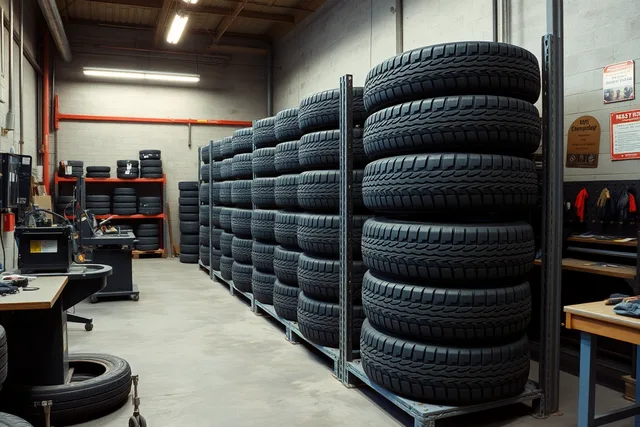
Opening stock. Units on hand at open is S times D. Cash tied up in it is S times D times C. Run that number twice, once with the size list you want and once with a list a third shorter. Look at the difference; it is often larger than any equipment line.
A 40-size list at four units a size is 160 tires. At a $90 average cost that is $14,400, and a list a third shorter saves close to $4,800.
Three Formulas That Matter
- Opening stockS times D times C
- Capacity ceilingB times H divided by T
- Runwaymonths until cumulative burn exceeds K
- Re-run runway with R a third lower
- Re-run runway with opening a month late
Capacity ceiling. With B bays running H productive hours and an average job time of T, jobs per day is about B times H divided by T. Multiply by operating days for the month. If your revenue projection needs more jobs than that, the projection is wrong. This is the check most opening budgets never run.
Two bays, eight productive hours each, and a 45-minute average job give about 21 jobs a day, or roughly 500 in a 24-day month.
Runway. Take opening cash after every purchase is paid for, and call it K. Monthly burn in month n is F minus the contribution the shop generates that month. Runway is how many months pass before cumulative burn exceeds K.
Do it as a month-by-month table rather than an average. The first six months are uneven, and an average hides the month you actually run out.
One worked version: F is $18,000, K is $40,000, and contribution runs $6,000, $9,000, $12,000, $14,000, then $15,000. Monthly burn falls from $12,000 to $3,000 over five months, and cumulative burn tops out near $34,000.
Now drop revenue by a third. Contribution in month one falls to $4,000, burn rises to $14,000, and the $40,000 is gone partway through month four.
Then run it again with the shop opening a month late. Those are the two things that most often happen, and a plan that survives both is a plan.
Where the money goes, in the order it commits
Where the money goes
- Deposits.Commercial space typically rents for $12 to $30 per square foot a year on a triple-net lease, so a 3,000-square-foot shop pays $3,000 to $7,500 a month. First month, last month and a security deposit total $6,000 to $15,000.
- Buildout.Converting a former garage is the cheap route. A gutted space costs $20 to $60 per square foot. Slab cutting for a lift runs $3,000 to $8,000 a bay, ventilation $2,000 to $6,000, and waste tire storage $500 to $2,000. Whatever makes the space legal for the work belongs here.
- Capacity equipment.A two-post lift costs $4,000 to $9,000 installed. A tire changer runs $3,000 to $9,000, a balancer $3,000 to $8,000, and a TPMS tool $500 to $2,000. A new two-bay package lands between $25,000 and $60,000, and used between $10,000 and $25,000. Justify each item by the sellable minutes it adds or the wheel damage it prevents.
- Opening stock.S times D times C. A common passenger size costs a dealer $70 to $130 mid-tier and $110 to $180 premium. Forty sizes at four units each, at a $90 average, is 160 tires and about $14,400 before freight.
- Payroll before revenue.Tire technicians earn $15 to $25 an hour in most US markets, and payroll taxes add 10% to 15%. Two technicians at $18 an hour cost roughly $1,600 a week with taxes, or about $21,000 over a 13-week quarter. Budget it as a fixed cost, not a variable one.
- Insurance, permits and waste setup.Garage liability with garagekeepers coverage typically runs $3,000 to $8,000 a year for a small shop. A business license costs $50 to $500. State waste tire registration or generator fees commonly fall between $100 and $1,000. Separately these look small; together they are not.
- Working capital reserve.Three to six months of fixed cost is the usual target. At the $18,000 monthly fixed cost used in the runway example, that is $54,000 to $108,000. This is the part everyone cuts and everyone regrets. It pays for the special order you have to eat and the month your busiest customer does not show up.
Deposits come to $9,000, buildout $40,000, and equipment $35,000. Opening stock adds $14,400, pre-revenue payroll $21,000, and insurance and permits $5,000. The total is about $124,000, before any reserve.
Ongoing costs that do not look like costs
Some money leaves the business without an invoice arriving.
Costs Without An Invoice
- Disposalper unit and per pickup
- Comeback laborrework bay time
- Claims administrationroad hazard programs
- Recall and registration handling
- Aged stockslow movers become write-offs
Ongoing costs
- Disposal.Old casings cost money per unit and per pickup, and whether you can recover it as a line item is set locally. Disposal typically runs $2 to $5 a tire in most US markets, and hauling adds $100 to $200 per pull.
- Comeback labor.Rework is bay time you already sold once, and it does not appear anywhere in a budget template. One comeback a day of 45 minutes, at a $90 shop rate, costs about $1,600 a month.
- Claims administration.Road hazard and warranty programs are a cost center. Programs commonly cost $2 to $6 per tire sold, and honoring a claim consumes your bay. Whoever administers the program sets the rules.
- Recall and registration handling.Selling tires carries administrative duties around registration and recall response. The current expectations are set out in the federal tire safety and recall guidance; check what applies to you rather than assuming it is free.
- Aged stock.Rubber that sits has a shelf question the manufacturer answers, not you. The DOT date code on the sidewall gives the week and year of manufacture, and many shops stop selling at six years. Slow movers become a decision, and eventually a write-off.
What each funding source actually costs
What each funding source costs
- SBA 7(a) term loan.SBA 7(a) loans price at prime plus 2.25 to 2.75 points, with terms to 10 years and 10% to 20% down. The cash cost is the lowest available if you qualify, and the payment arrives whether or not the shop is busy. The slow first quarter is exactly when that hurts.
- SBA lender types.Community banks, credit unions and online lenders such as Live Oak Bank originate 7(a) loans; the SBA itself does not lend.
- SBA 504 for real estate.Buying the building splits the project between a bank and a CDC. The debenture portion typically prices at 6% to 7.5% fixed over 20 years, with 10% down. It is the cheapest long money, and the slowest to close.
- Equipment financing.Ties the debt to the asset, which is sensible, and often needs less collateral. Expect 7% to 15% APR over three to five years with 10% down. It also makes it easy to buy more capacity than the bay count can use.
- Supplier terms.Supplier credit funds your inventory, which is where the money is. Net 30 is standard, with a 1% discount for payment inside 10 days. Distributors such as American Tire Distributors and US AutoForce open accounts on a resale certificate and a personal guarantee. Terms narrow who you can buy from and how hard you negotiate later.
- Personal funds and home equity.No interest, no covenants, and the highest real risk. It also removes the one useful thing a lender does, which is force you to write a defensible plan. A home equity line usually prices at prime plus a small margin, so in the 8% to 10% band.
- Outside equity.Buys time rather than a payment schedule, and costs you the ability to make decisions alone. Typical terms in small service businesses run from 20% of the company for $50,000 to 40% for $150,000, sometimes with a capped payout instead of a permanent stake.
- Cards and merchant advances.Business credit cards price at 18% to 29% APR. Merchant cash advances quote a factor rate of 1.1 to 1.4, which is a 10% to 40% cost collected over a few months. Both are the most expensive money on this list, and the fastest to arrive.
The SBA's guide for new business owners sets out how the financing options sit alongside the licensing and registration steps. The IRS page on starting a business covers the records that any lender will eventually ask you to produce.
Getting the document into shape is a separate exercise, worked through in the material on what belongs in the written plan.
Where these numbers come from
Every figure above is a typical US range for 2026, not a quote from a supplier. Rent, wages and disposal costs move by market, so replace them with local numbers before you commit.
The trade-area counting that sets S and the demand side of R is in the startup and market guide. Which commitments deserve the most caution, and in what order, is covered in the four decisions you cannot undo.
Payroll assumptions and how peak weeks get covered without carrying peak headcount come from the hiring and training guide. Any line item for a second site belongs with the reasoning on when another location pays for itself.
Common questions
How much should I hold in reserve?
Enough to reach the month your own runway table says the shop covers its fixed cost, plus the same amount again for the version where revenue comes in a third lower. In the example above, the base case needed $40,000. Nobody can give you the dollar figure without your rent and your bay count.
Is used equipment a real saving?
A used two-post lift at $2,000 to $4,000 against $4,000 to $9,000 new is a real saving if the machine is serviceable and parts are available. It is not a saving if it takes a bay out of service for a week or damages a customer's alloy. Judge it on downtime risk, not sticker price.
Should I finance the opening stock?
Supplier terms are the usual answer, and they are reasonable if you understand you are buying flexibility with them. What is rarely reasonable is borrowing to hold depth in sizes you have not yet counted on your own road.
A $14,400 opening stock financed at 12% costs about $1,700 in the first year.
What is the single most common budgeting error?
Setting the revenue projection above the capacity ceiling. It is invisible in a spreadsheet, it survives every review, and it is arithmetically impossible.