Guides
Making sense of tire shop hiring and training
Tire shop hiring and training around the skill ladder: what each rung must do unsupervised, how to staff peak weeks, and why technicians actually leave.
What to take away
- Define the ladder by what a person can do unsupervised, not by job titles. That is the only definition a schedule can use.
- The shop's capacity is the number of people who can produce a finished wheel to standard without being checked. On the ladder, that means Fitter and above, not raw headcount.
- Cross-train for the peak weeks. Hiring for them and carrying that headcount all year is how a shop bleeds.
- Technicians usually leave for reasons that are cheap to fixbroken tools, chaotic scheduling, and a shop that blames rather than fixes.
- Everything about pay, hours, classification and hiring decisions is governed by rules. Learn them before the first hire, not after.
The ladder, defined by unsupervised capability
Titles are useless for scheduling. What a schedule needs to know is who can be given a job and left alone with it.
Skill ladder by unsupervised work
Rung
- New
- Fetch, stage, clean, break down
- Fitter
- Mount, balance standard fitments
- Technician
- Sensors, awkward wheels, verify torque
- Senior technician
- Repair assessment, diagnose vibration, mentor
- Advisor
- Quote, explain findings, stop-show-quote
Can do unsupervised
- New
- Anything touching customer's wheel
- Fitter
- Difficult wheels, sensors, repairs
- Technician
- Repair judgment on marginal casings
- Senior technician
- Nothing routine
- Advisor
- Bay work unless separately trained
Cannot yet
- New
- Fitter
- Technician
- Senior technician
- Advisor
The ladder, defined
| Rung | Can do unsupervised | Cannot yet |
|---|---|---|
| New | Fetch, stage, clean, break down old sets, waste handling | Anything that touches a customer's wheel |
| Fitter | Mount and balance standard fitments, set pressures | Difficult wheels, sensors, any repair decision |
| Technician | Full fitment including sensors and awkward wheels, verify torque | Repair judgment on marginal casings |
| Senior technician | Repair assessment against the written policy, diagnose vibration, mentor | Nothing routine; this is the shop's standard |
| Advisor | Quote, explain findings, handle the stop-show-quote conversation | Bay work, unless separately trained |
Two consequences. First, capacity is the count of people at Fitter and above, not headcount. Second, promotion means a documented demonstration, not time served, because a rung is a claim you are making to every customer.
Where the ladder actually binds
The rung that limits most shops is Technician, and specifically the ability to handle sensors and large-diameter alloys without damage or delay. That is where jobs pile up, where the wide time spreads come from, and where a single person becomes a single point of failure.
Fix it deliberately. Identify every task only one person can do and treat each as a training target with a date. A shop where the busy Saturday depends on one individual is a shop with a scheduling problem it has chosen not to solve.
Staffing the shape of the year
The year is not flat. Where seasonal tires are common, two or three changeover weeks carry a share of volume far above their share of the calendar, and weather events produce unplanned spikes on top.
Three approaches, and most shops use all three.
- Cross-train the whole crew to Fitter.In a peak week, everyone who can mount and balance is capacity, including people who normally work the counter.
- Use seasonal help on the low rung.New-rung work is real work: staging, breaking down, waste handling, moving vehicles. Freeing a technician from it is the same as adding technician hours.
- Book the peak instead of absorbing it.Bookings taken and confirmed in advance turn a chaotic week into a full one, which is a staffing solution disguised as a scheduling one.
What does not work is hiring at peak headcount and carrying it through the quiet months. That cost is fixed and the revenue is not.
What a job posting should say
Be specific, because specificity filters better than enthusiasm.
What a job posting should say
- Actual workvehicle classes, wheel types
- Equipment they will use, by category
- Physical reality of the job, honestly
- Shift pattern including changeover weeks
- What shop providestooling, training, PPE
- Rung hiring at and moving up requirements
A posting that works carries these lines:
- Rung and titleTire Technician, Fitter and above.
- Duties done unsupervisedmount and balance standard fitments, set pressures to the placard, torque to spec with a calibrated wrench.
- Not expected yetrepair decisions on marginal casings, sensor relearns, alignment work.
- Scheduledays, hours, and how peak weeks are staffed.
- Paya stated range and the pay period.
- Toolswhat the shop provides and what the technician brings.
- Physical demandslifting limits and standing time, stated plainly.
- How to apply, and what the first week looks like.
Job requirements have to relate to the job. Federal expectations around hiring, and the resources for small employers, are set out by the EEOC's small business resource center, and states add their own. Read that before you write a posting rather than after somebody objects to one.
Hiring for judgment, not just hands
Speed is trainable. Judgment is the thing that protects the shop, and it shows up in a few specific questions.
Ask what they do with a casing that looks marginal. A good answer names the tire manufacturer's instructions and the shop's written policy, not their own feel.
Ask what they do when a wheel arrives already curbed, or when the job needs a stop-show-quote conversation. A good answer: they photograph and show the customer before touching the wheel, and they stop until the customer decides.
A working interview, paid, on real jobs, tells you more than any of it. Watch three things: whether they photograph and note wheel condition without being told, whether they reach for calibrated torque tooling by default, and whether they ask when they are unsure.
Training that produces consistency
The point of training in a tire shop is not skill in the abstract. It is that two technicians produce the same finished wheel.
Training for consistency
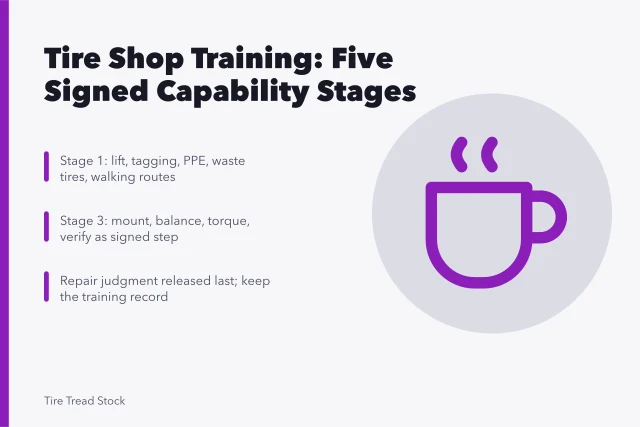
- Train to written procedure, keep it short
- Sign off capability with dated demonstration
- Retrain against quality sampling findings
- Practice stop-show-quote counter conversations
- Include trade-specific safety content
For outside material, the Tire Industry Association runs automotive and commercial tire service training, and tire makers publish their own mounting and repair procedures.
Work each rung as a sequence, with a sign-off at the end:
- Watch three complete fitments while the trainer narrates each step.
- Perform three fitments with the trainer watching and correcting.
- Perform five fitments that end with a torque check and a photo of wheel condition.
- Demonstrate the rung unaidedmount and balance a standard alloy, set pressures to the placard, torque to spec, and record wheel condition.
The sign-off gets a date and goes in the personnel file. That record is what turns a rung from a title into evidence.
Pay, hours and classification
This is rules territory, and mistakes are costly. Rules, not preference, decide whether someone is an employee or a contractor, and hours worked must be recorded in the required form.
Overtime, breaks, and pay frequency are governed; states often layer stricter requirements on top of the federal floor. The Department of Labor's resources for new and small businesses is the federal starting point.
For setting pay levels, the Bureau of Labor Statistics occupational tables give published local data. That is a defensible reference for your area and occupation, a better anchor than a figure a competitor mentioned.
Start with the BLS median for tire repairers and changers in your own metro. Nationally that median has sat in the mid to high teens per hour in recent years, and metro medians spread well above and below it.
A typical posted range for a Fitter at an independent US shop runs from about $16 to $24 per hour, with the top of the band for people who handle sensors, run-flats and large alloys without help. Read those as typical ranges, not a target.
Hourly bay work is almost always non-exempt, so overtime after 40 hours in a workweek is the floor. A salary and a title do not create an exemption on their own. The duties test and a salary threshold both have to fit, and that threshold has moved in recent litigation.
Several states, including California, Colorado, New York and Washington, require a pay range in the posting itself. Check your state before you publish one.
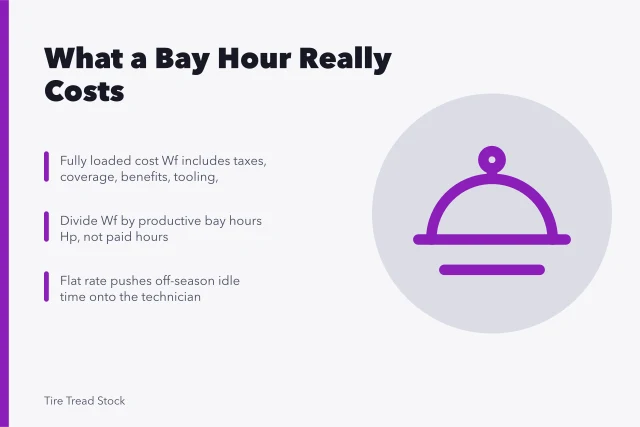
No page gives your own number. It depends on your labor cost per productive bay hour and what your prices support.
Why technicians leave, and what it costs
Turnover in a bay is expensive in a specific way: you lose a rung, and the schedule loses the jobs that rung could do unsupervised. The reasons are usually mundane.
Why technicians leave
- Tooling that does not work, or that they have to buy themselves without it being clear in advance.
- A schedule that is chronically overbooked, so every day feels like failure.
- Being blamed for comebacks caused by a drifting machine.
- No path. A person at Fitter with no visible route to Technician will find one somewhere else.
- Peak weeks handled by shouting rather than by planning.
Every one of those is cheaper to fix than to replace a technician.
How staffing connects to the rest of the shop
Crew capability sets the service menu, since a service only one person can do is not really on the menu. That decision belongs with the services and packages guide.
Labor cost per productive bay hour is the main input to the price list in the pricing and profit guide. The flow that training must produce consistency across is set out in the operations and workflow guide.
Equipment decides what you can train on and how fast a job runs, as covered in the equipment and setup guide. Employment obligations sit inside the wider regulatory map in the licensing and compliance guide. Demand decides how many people the shop can support, the counting exercise in the startup and market guide.
Common questions
Should I hire experienced technicians or train my own?
Both, and the mix depends on what you can supervise. An experienced hire brings a standard, which is useful if it is a good one and a problem if it is not. Training your own is slower and produces people who work to your written procedure by default.
How do I judge experience I cannot verify?
A paid working interview on real jobs. Resumes describe employers; a morning in the bay describes the person, and it also tells them whether they want to work in your shop.
What should the shop supply?
Whatever is required, plus enough that a technician is never working around a missing tool. Whatever your policy is, state it in the posting, because tooling expectations are one of the most common sources of resentment in this trade.
Can I pay a percentage of the work billed?
Pay structures are regulated and the details differ by state. Ask before you design one, and note that any structure rewarding speed needs a counterweight in your quality sampling, or the shop will get exactly what it measures.
How long does it take to reach the Technician rung?
That depends entirely on the person and on how much varied work your shop sees. Measure it by demonstrations passed rather than by months, since months are a proxy for the thing you actually care about.