Guides
Booking tire shop jobs without gaps or overruns in 2027
Tire shop scheduling that holds: slot design from measured bay times, buffer placement, how to book a changeover week, and the four rules that stop cascades.
What to take away
- A schedule fails at the first long job, not at the tenth. One overrun early cascades through everything behind it.
- Build slots from measured bay times including the slow end of the spread, not from the average.
- Buffer goes in the middle of the day, not at the end, because a buffer at the end absorbs nothing.
- Never book a job whose tire has not been confirmed on the rack or on a confirmed delivery.
- In a changeover week the schedule is the business. Fill it early, confirm it, and hold it.
Why schedules cascade
A tire shop schedule is a queue in front of one resource. When a job runs over, every job behind it starts late. The delay grows because no slack absorbs it.
By mid-afternoon the shop is an hour behind, and the customers who booked at four will not come back.
Two structural properties cause this. Job times have a wide spread, and the shop has no idle capacity to recover into. Both are fixable in the schedule design.
Step 1: measure before you design
Time every service for a month, from the moment the vehicle occupies the lift to the moment it leaves. Record the spread, not just the average. You need three numbers per service: the typical time, the slow end, and how often the slow end happens.
Most shops discover two things. Menu times are optimistic. And one or two services have a much wider spread than the rest, usually anything involving sensors, seized hardware or vehicles the shop does not see often.
Step 2: design slots from the slow end
Design slots from the slow end
| Service type | Slot rule | Why |
|---|---|---|
| High-volume fitment, narrow spread | Slot at typical time | Predictable enough to pack |
| Anything with a wide spread | Slot at the slow end | Booking these at the average guarantees a cascade |
| Repair assessment | Slot at the assessment, not the outcome | You do not know yet whether it becomes a replacement |
| Long-bay work such as alignment | Its own booked slot, never a gap fill | It blocks everything behind it |
| First job of a vehicle type you rarely see | Slot generously, and time it | Today's measurement is tomorrow's slot |
The instinct to book at the average comes from wanting to fit more jobs in. It fits fewer, because the recovery time from a cascade costs more than the slack you saved.
Step 3: place buffer where it works
Buffer at the end of the day absorbs nothing, because by then the damage is done and the last customer is already waiting. Put an unbooked slot in the late morning and another in the mid-afternoon. Those are the two points where a shop can still recover.
The buffer is not empty time. It is where walk-ins go, where the comeback gets fixed, and where the job that ran long finishes without pushing anyone else.
Step 4: four rules that prevent most delays
Four rules that prevent delays
- No booking without a confirmed tire.The size is verified on the rack or on a confirmed delivery at the moment the appointment is made. This single rule removes the most expensive delay in the shop: the car on the lift and the tire that is not there.
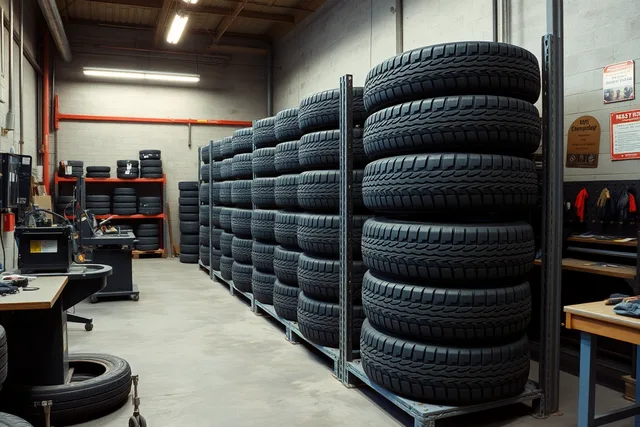
- Stage the night before.Tires pulled and labeled by vehicle at the end of the previous day. Fifteen minutes when nobody is waiting replaces a search when everybody is.
- One vehicle, one lift, one job.A car parked on a lift waiting for a decision is a closed bay. Move it off or get the decision.
- Stop, show, quote, proceed.When something unexpected is found, the sequence is identical every time. An ad hoc decision mid-job is what turns a twenty-minute overrun into an hour.
Step 5: schedule the changeover week differently
Where seasonal tires are normal, two or three weeks carry a share of the year's volume far above their share of the calendar. Those weeks are won or lost in the booking, not in the bay.
Schedule the changeover week differently
- Open bookings early and confirm them. The same customer calls several shops and takes the first firm time offered.
- Use fixed-length seasonal slots based on measured time for that exact job, and do not accept anything else into them.
- Stage every set the day before. In a peak week this is the difference between a full day and a chaotic one.
- Decide in advance what you will refuse. There is no time to make that call in the week itself.
- Keep the buffer slots. The temptation to sell them is strongest exactly when you need them most.
Storage customers are the quiet advantage here, because their changeover is already scheduled and their tires are already in the building.
Step 6: handle the interruptions on purpose
Three things arrive unannounced and all three can be planned for.
Walk-ins. Accept into buffer with a stated wait, or book them for later. Never into a slot a booked job needs.
Comebacks. These take priority for the customer's sake and cost you bay time you already sold. Put them in buffer, track the minutes lost by service, and treat a rising rate as a machine or process problem rather than a person problem.
Emergencies. A vehicle that is genuinely unsafe to drive is a different category. Have a rule for what qualifies and who decides, so it is not renegotiated each time.
What the schedule cannot fix
Some delays are not scheduling problems.
- A machine that is down. Maintenance to the manufacturers' schedules, and a plan for what happens when a machine fails on a Saturday, are covered alongside the buying decisions in the equipment and setup guide.
- A crew where only one person can do a given job. That is a training gap, addressed in the hiring and training guide.
- A safety stop. Any condition covered by the shop's safety rules stops the job, and the hazard categories those rules should address are documented in OSHA's overview of automotive repair and refinishing work.
- A refusal. Where a casing must not be repaired, the schedule loses time and the answer is still no. That decision follows the tire manufacturer's instructions and published industry repair guidance, and the wider fitment and recall context is set out in the federal tire safety guidance.
Reviewing the schedule
Once a month, compare booked time against actual time by service, and look at where the day fell apart. Keep the job records that let you do it, since the IRS guidance on records a business should keep covers holding them properly, and they are the same records you need for everything else.
Then adjust slot lengths, because a schedule never adjusted rests on a guess made once. The wider flow scheduling sits inside, from inquiry through follow-up, is set out in the operations and workflow guide.
Whether local demand supports your slot pattern is a trade-area question, developed in the market and expansion guide. Some scheduled work exists to satisfy an obligation whose source is mapped in the licensing and compliance guide.
Common questions
How far ahead should we take bookings?
Far enough that changeover weeks fill, which usually means opening those bookings weeks in advance. For ordinary work, a shorter horizon keeps the schedule flexible and reduces the number of people who forget they booked.
Should we take deposits?
For seasonal slots and for special-order tires, many shops do, and it reduces no-shows sharply. Whatever you decide, state the terms at booking rather than at arrival.
What do we do when the schedule collapses anyway?
Call the affected customers before they arrive. A customer told at nine that their eleven o'clock has moved is inconvenienced. A customer who discovers it in your waiting room is lost.
Is an online booking system worth it?
It helps if it can confirm stock, or if it books only into slot types you have defined. A system that takes any booking at any time without checking either is a machine for creating delays.
How much buffer is enough?
Enough that a typical overrun does not reach the next customer, which you can read directly off your measured spread. Start with two slots a day and adjust from what actually happens.