Guides
Tire shop owners referrals: the habits that generate them
Referrals for a tire shop: the four sources that actually send work, what makes each one refer, and why paying for reviews is a different thing entirely.
What to take away
- Referrals in this trade come from four identifiable sources, and three of them are businesses rather than customers.
- What earns a trade referral is refusing work honestly and referring back. Nothing else is as reliable.
- Customers refer after a moment they can retella repair you would not do, a wheel you photographed, a price that did not move.
- Ask directly and specifically. A general request produces nothing; naming the situation produces referrals.
- A referral arrangement is not a review. Reviews have their own rules and incentives are not permitted there.
The four sources
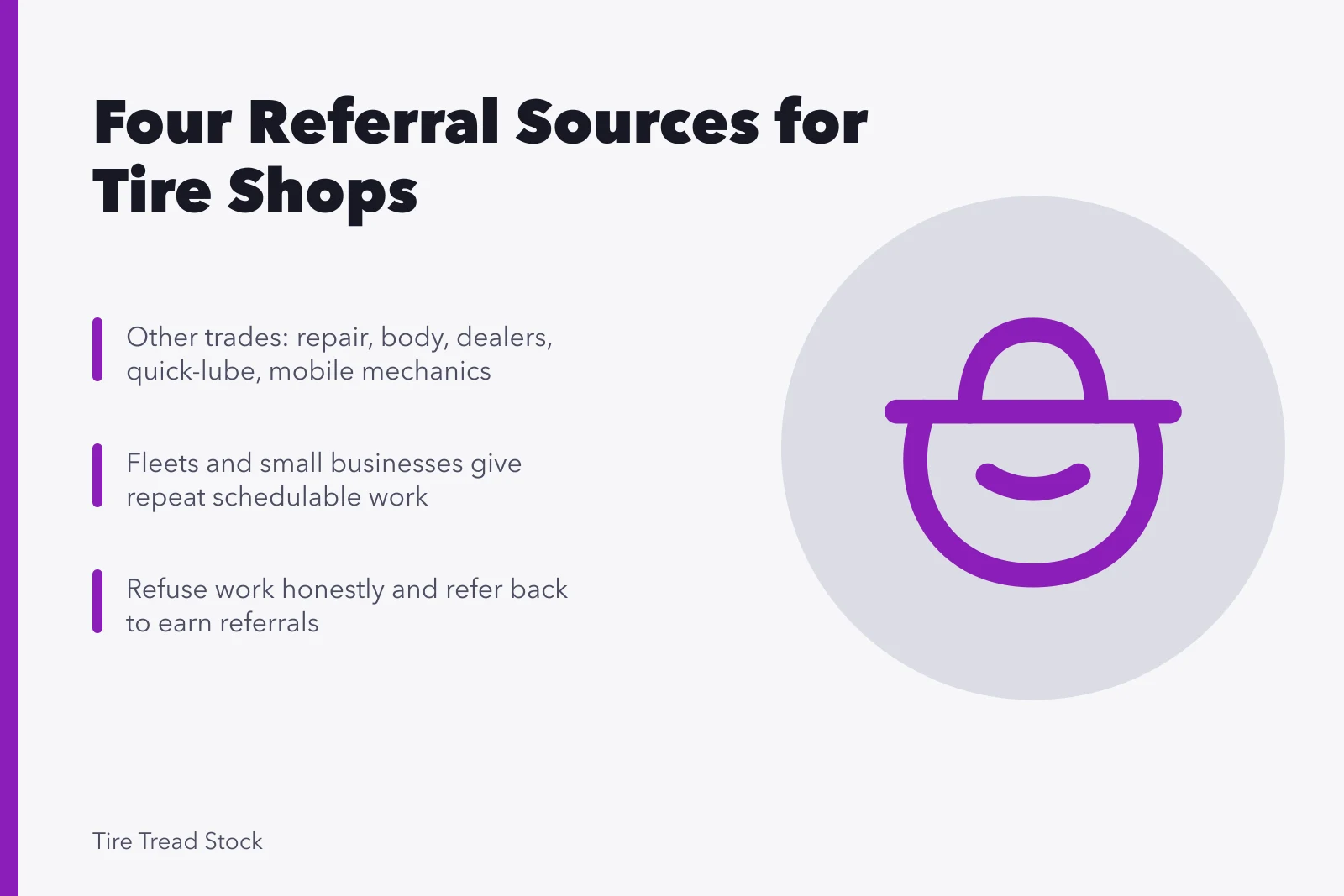
1. Other trades. General repair shops, body shops, dealers, quick-lube operations and mobile mechanics all touch tires and most of them do not want the work. This is the largest and steadiest source, and it is almost entirely neglected by shops that spend money on advertising instead.
2. Fleets and small businesses. A contractor with vans, a landscaping crew, a delivery operation. One relationship produces repeat, schedulable work and referrals to peers in the same trade.
3. Customers. Individually smaller but cumulatively large, and free. They refer after a specific experience, not after a good average one.
4. Suppliers. Distributors and their drivers see every shop in the area and are asked for recommendations regularly. Being easy to deal with pays here in a way that is hard to measure and easy to notice.
What makes another shop refer to you
Put yourself in their position. They send you a customer, and what comes back reflects on them. So they are not choosing the cheapest shop. They are choosing the one least likely to embarrass them.
What earns another shop's referral
- Refer back honestly, not one-way
- Refuse work your written policy prohibits
- Answer fast and give a firm time
- Never poach the customer they sent
Four things earn it.
- You refer back honestly.A tire shop that sends alignment-adjacent suspension work, brake work and diagnostics to the shop that sent it tire work builds something durable. A one-way relationship ends quietly.
- You refuse work you should refuse.A shop that will not perform a repair its written policy prohibits is a shop another professional trusts. The policy should come from the tire manufacturer's instructions and published industry repair guidance, and being visibly consistent about it is the entire signal.
- You are reachable and quick.Their customer is waiting. A shop that answers and gives a firm time is the one they call again.
- You do not poach.If they sent you a customer for tires, you send that customer back for everything else. Once.
Go and introduce yourself in person. This is a trade where a conversation and a card do more than any campaign, and almost nobody bothers.
What makes a customer refer
Customers do not refer because the price was fair. They refer because something happened that they can retell in one sentence.
What makes a customer retell it
- Showed pre-existing wheel damage before touching it
- Refused a repair and named the standard
- Stopped, showed the find, quoted first
- Gave a time and kept it
- Pickup price matched the quote exactly
- You showed them a wheel that was already damaged before you touched it.
- You refused a repair and explained why, and the explanation named a standard rather than a preference.
- You found something and stopped, showed them, and quoted before doing it.
- You gave a time and kept it.
- The price at pickup matched the quote exactly.
That last one is unglamorous and it is the most common reason people recommend a shop in this trade. The surprise at pickup is what customers actually resent.
Ask at the moment the story is fresh, and ask specifically. "If anyone you know is putting off tires because they think it will be a hassle, send them to me" produces referrals. "Tell your friends about us" does not.
Building a fleet or business referral
A small business relationship is worth more than its own volume because it refers to peers.
Running a fleet relationship
- Name one contact on each side
- Agree and keep a rotation interval
- Give a record filled in the same way
- Be predictable about turnaround
- Say early when you cannot do it
- Name a single contact on each side.
- Agree a rotation and inspection interval and keep to it.
- Give them a record they can actually use, filled in the same way every time.
- Be predictable about turnaround. Predictability is what they are buying.
- When you cannot do something, say so early rather than at the end.
Then ask that contact directly whether they know anyone running a similar operation. They almost always do.
Referral arrangements and where the line is
Paying or rewarding someone for sending you business is a normal commercial arrangement in many contexts, and it can be legitimate here. What it must not be is hidden from the customer, and it must never be attached to a review.
Referral fees vs. reviews
Referral arrangement
- Allowed
- Yes, if disclosed
- Customer told
- Must be
- Incentive
- Legitimate
- Who is asked
- Any source
- Written by
- Anyone
Review
- Allowed
- Never paid
- Customer told
- Not applicable
- Incentive
- Prohibited
- Who is asked
- Not only happy ones
- Written by
- Never yourself
Reviews are separate and follow their own rules. Never pay for them, offer anything in exchange, ask only happy customers, or write them yourself.
The FTC's guidance for marketers on soliciting and paying for online reviews explains what is expected. A referral program that quietly becomes a review incentive is exactly the failure it addresses.
Making referrals visible to yourself
Referred work is invisible unless you record it.
Making referrals visible
- Ask every new customer how they found you
- Record the source's name or business
- Thank the source with a phone call
- Count referrals by source each quarter
- Call a quiet source and find out why
- Ask every new customer how they found you and record the answer, including the name of the person or business who sent them.
- Thank the source. A phone call to another shop's owner saying you sent them a customer back is worth more than any card.
- Count referrals by source each quarter and see which relationships are real.
- When a source goes quiet, call and find out why. It is usually something specific and fixable.
What referrals depend on
A referral is a promise someone else made about your shop, so the shop must keep it. The counter behaviors that turn a referred customer into a repeat one are covered in the piece on where tire shops lose customers.
Being reachable and findable when that referral becomes a search is covered in the local search material.
Consistency in the bay makes a referral safe to give. It comes from the crew and the standard in the hiring and training guide.
Where referrals sit among other channels, and how the seasonal calendar shapes them, is in the marketing and growth guide.
If a referral network is strong enough to support a second site, that judgment belongs with the reasoning in the market and expansion guide.
One practical note on discoverability: when someone acts on a referral they usually search for you first, and Google's documentation on how a business profile's local ranking works explains what its own product weighs. A referred customer who cannot find correct hours may not arrive.
Common questions
Should I pay other shops for referrals?
Some shops do and it can be legitimate, provided it is disclosed where disclosure is expected. In practice, reciprocal referral and reliability produce more durable relationships than a fee does, because a fee makes you replaceable by a higher fee.
How do I start a relationship with a general repair shop?
Visit in person, at a quiet hour, and lead with what you will send them rather than what you want. Be specific about what you do and what you refuse.
What if a referred customer has a bad experience?
Call the referring business before they hear it from their customer. Handling it openly usually protects the relationship; letting them find out does not.
Do referral cards work?
Only as a memory aid attached to a specific conversation. A stack of cards on a counter does nothing.
How long does it take to build a referral base?
Months, and it compounds. It is the slowest channel to start and the cheapest to maintain, which is why it belongs in the quiet season rather than in the weeks when the shop is already full.