Guides
How to plug the four leaks costing a tire shop new customers
Winning tire shop customers by fixing the four points where they are lost: the unanswered phone, the vague quote, the wait, and the missed follow-up.
What to take away
- Most tire shops lose more customers at the counter than they ever lose to a competitor's advertising.
- Four leaks account for nearly all of itthe phone nobody answers, the quote nobody understands, the wait nobody warned about, and the follow-up nobody made.
- Fixing a leak costs almost nothing and works immediately. Advertising into a leaking shop pays for the leak.
- Track how each caller found you and whether they booked. Two numbers, kept for a month, will surprise you.
- The person who bought four tires today is the cheapest customer you will ever get again. Most shops never contact them.
Leak one: the phone
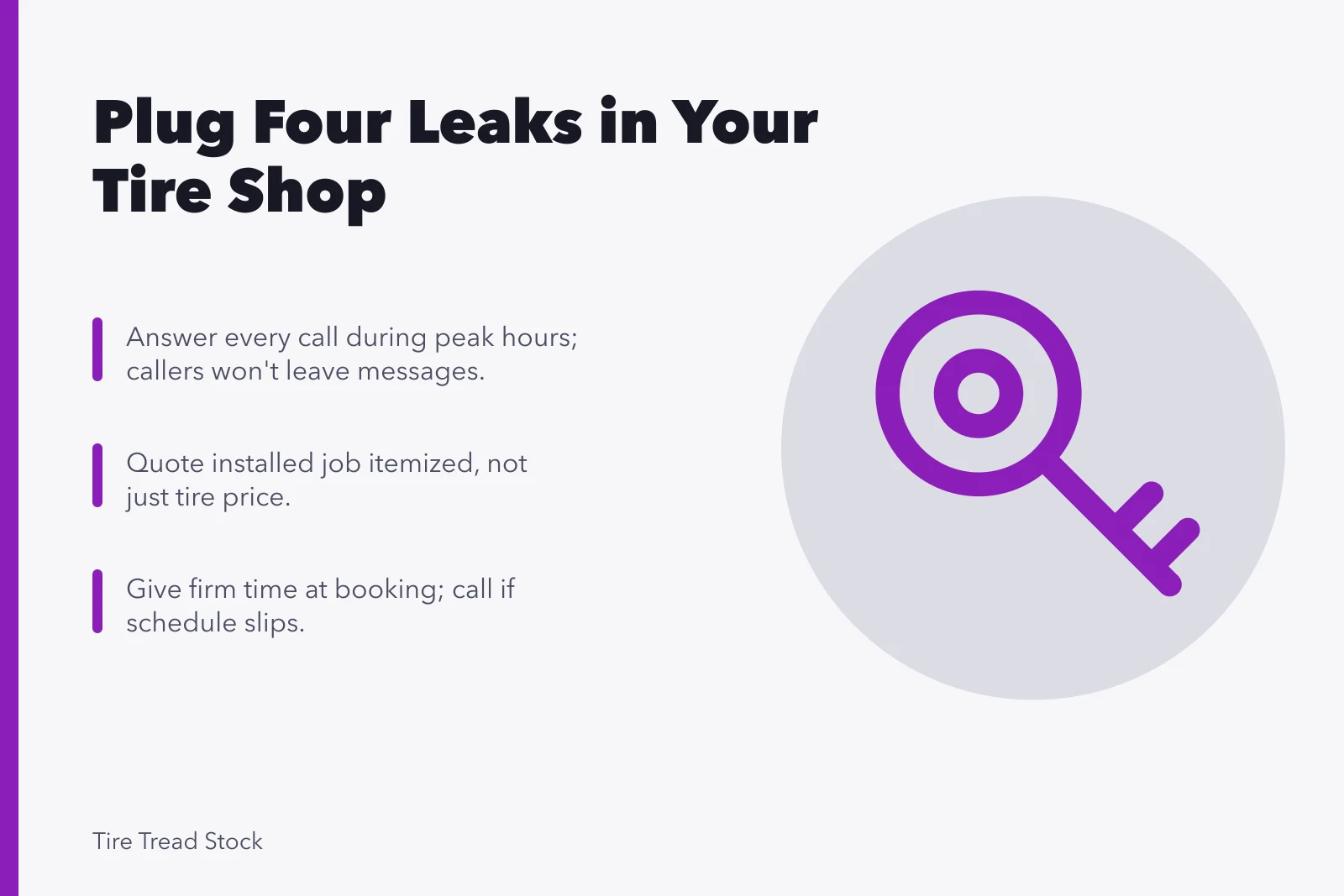
The single largest source of lost tire work is a call that went unanswered during the busiest hour of the day. The caller does not leave a message. They call the next shop.
- Decide who owns the phone during peak hours, and make it a role rather than whoever is nearest.
- Answer with a name and the ability to check stock, because a call that ends in "let me find out and call you back" usually ends there.
- If you genuinely cannot answer, return calls within a defined window and say so on the greeting.
- Track missed calls. Most phone systems will tell you, and the number is usually worse than owners expect.
A shop that answers the phone reliably beats a shop with a larger advertising budget in the same radius, because the demand is urgent and it goes to whoever picks up.
Leak two: the quote nobody understands
A caller asks what four tires cost. If the answer is a single number for the goods, you have invited a comparison with an online price, and you will lose it.
Quote the installed job instead, and itemize it out loud: the tire, mounting, balancing, valve or sensor service, torque to the vehicle manufacturer's specification, and disposal of the old set. Then name the variable items and the stop rule, so nothing is a surprise later.
That takes twenty seconds and changes what is being compared. Any price you state publicly carries an expectation with it: a price implying a finished job has to deliver a finished job. The honest version is also the persuasive one here.
Decide in advance whether you fit customer-supplied tires and publish the answer. Being unclear about it costs you the booking and the goodwill at once.
Leak three: the wait nobody warned about
Customers accept waiting. They do not accept being surprised by it.
Leak three: the wait
- Give a firm time at booking, based on measured bay time rather than optimism.
- If the schedule slips, call before they arrive. A customer told at nine that their eleven has moved is inconvenienced; one who discovers it in your waiting room is gone.
- Tell waiting customers what is happening at least once during the job, without being asked.
- Never leave a vehicle on a lift waiting for a decision. Get the decision or move the car.
The stop, show, quote, proceed sequence belongs here too. Handled well it builds trust, because the customer sees the thing you found. Handled badly, as a phone call at pickup, it reads as an upsell.
Leak four: the follow-up nobody made
The person who bought a set today is the cheapest customer you will ever get again, and most shops never contact them.
Leak four: the follow-up
- Record what was fitted, when, and what was found but declined.
- Contact seasonal and storage customers before the changeover weeks and book them. This is the highest-return outreach available to a tire shop.
- Follow up on declined work once, factually, without pressure.
- Ask every customer for a review, the same way, at the same point.
On reviews, the rules are firm: no payment, no incentive, no asking only the happy ones, and nothing written on a customer's behalf. The FTC's guidance on soliciting and paying for online reviews covers what is expected, and it is worth reading before designing any review process.
Being findable when the need is urgent
Most tire demand is a person with a problem searching nearby, right now. Being present and accurate in that moment is the whole game. Google's own documentation on improving a business profile's local ranking describes how its ranking treats relevance, distance and prominence, which is the authoritative source on how that particular product behaves.
The basics matter more than any tactic: correct hours including seasonal changes, a phone number that is answered, photographs of the actual shop, and a service list that matches what you really do.
Measure two numbers
Ask every caller how they found you and record whether they booked. That is it.
After a month you will have cost per booked job by channel, and most shops discover that two channels produce nearly everything while several line items are habits nobody has questioned. Move the budget accordingly.
The second thing that measurement reveals is capacity. If bookings are being turned away or pushed weeks out, more demand is not the answer, and spending on it converts into long waits and the reviews that follow. Growth in demand has to be matched by growth in capacity, which is a staffing and equipment question rather than a marketing one.
Fix the shop before you advertise it
Advertising multiplies whatever the shop already does. A shop with a comeback problem, an unanswered phone or a chaotic schedule will get more of exactly that.
The order that works: fix the four leaks, then confirm the operating flow can absorb more work, then spend. The flow itself, from inquiry through follow-up, is set out in the operations and workflow guide, and the capability to absorb volume comes from the crew described in the hiring and training guide.
The wider channel picture, seasonal calendar, and budget framing are in the marketing and growth guide.
What you may claim is partly a local compliance matter, mapped in the licensing and compliance guide. Whether demand in your radius supports your growth target is the counting exercise in the market and expansion guide.
Common questions
What is the fastest way to get more customers?
Answer the phone during your busiest hour and contact your own past customers before a changeover season. Both work immediately and neither costs anything beyond attention.
Should I discount to win a price shopper?
Rarely. A customer who chose you on price alone will leave on price alone, and the discount comes out of the labor margin that funds the shop. Compete by making the comparison honest instead.
How do I get more reviews?
Ask everyone, the same way, right after the handback, with one link. Do not incentivize, do not filter, and respond to the negative ones by fixing what they describe.
Is it worth advertising in the peak weeks?
Usually not. Demand is already there and capacity is the constraint. Spend that effort on booking and staging so the week runs cleanly, and put advertising in the shoulder months where it fills empty bays.
How do I win fleet work?
By being reliable and easy to deal with rather than cheap. Fleets buy predictability: a named contact, a rotation interval, simple paperwork, and vehicles back when promised.