Guides
9 points worth checking on tire shop marketing
Tire shop marketing that fills bays: the local demand pattern, the seasonal calendar, reputation as the main channel, and what to measure per booked job.
What to take away
- A tire shop sells to people within a short drive who need something today or this week. That single fact rules out most general marketing advice.
- Reputation and local search do the heavy lifting. Everything else is a supplement to those two.
- Market to the calendar. Changeover weeks and the first cold snap are when demand exists, and a campaign that arrives afterward is wasted.
- Measure cost per booked job, not impressions. A booked job is the only outcome a bay can use.
- Never pay for a review or offer anything in exchange for one. It is a rule, not a preference, and it is enforced.
What you are actually selling into
Three properties of tire demand shape everything below.
It is local. Almost nobody drives past three shops to reach a fourth. Your market is a radius, and the radius is short.
It is urgent or scheduled, rarely browsed. A person either has a problem now, or a changeover they have been meaning to book. There is little middle ground and almost no impulse purchase.
It is compared on price for the goods and on trust for the work. The tire has a public price. What you do with it does not. Marketing that competes on the first term is competing on the one you cannot win.
The channels that fit that shape
What it does
- Local search presence
- Puts you in front of urgent demand
- Reviews and reputation
- Decides which of the nearby shops gets the call
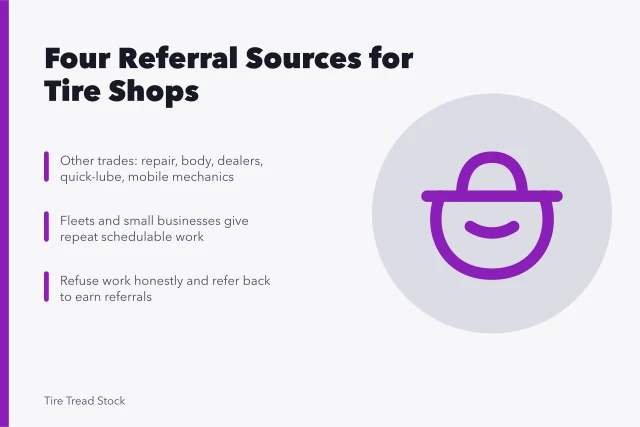
- Referrals from other trades
- Steady, pre-qualified work
- Fleet relationships
- Fills bays on quiet days
- Signage and visibility
- Cheap and permanent
- Seasonal reminders to your own customers
- Highest return of anything here
- Paid local advertising
- Fast, controllable
Where it fails
- Local search presence
- Neglected listings; wrong hours; no photos
- Reviews and reputation
- Any attempt to manipulate it
- Referrals from other trades
- Requires you to refer back honestly
- Fleet relationships
- Needs a named contact and simple paperwork
- Signage and visibility
- Useless if the turn-in is difficult
- Seasonal reminders to your own customers
- Requires records you may not be keeping
- Paid local advertising
- Expensive if it points at a shop that cannot take the work
Notice what is missing. Broad brand advertising, social content unrelated to service, and anything aimed at people outside the drive radius. Those consume budget and produce nothing a bay can use.
Channels: fit and failure
Channel
- Local search
- Urgent demand
- Reviews
- Decides the call
- Referrals
- Pre-qualified work
- Fleet
- Fills quiet days
- Signage
- Cheap, permanent
- Seasonal reminders
- Highest return
- Paid local ads
- Fast, controllable
What it does
- Local search
- Neglected listings
- Reviews
- Manipulation
- Referrals
- Must refer back
- Fleet
- Needs contact
- Signage
- Hard turn-in
- Seasonal reminders
- Needs records
- Paid local ads
- Expensive if full
Where it fails
- Local search
- Reviews
- Referrals
- Fleet
- Signage
- Seasonal reminders
- Paid local ads
The seasonal calendar
The year is not flat, and marketing spent at the wrong point in it is wasted almost entirely.
Seasonal marketing calendar
- Before changeover weeksBook own storage customers
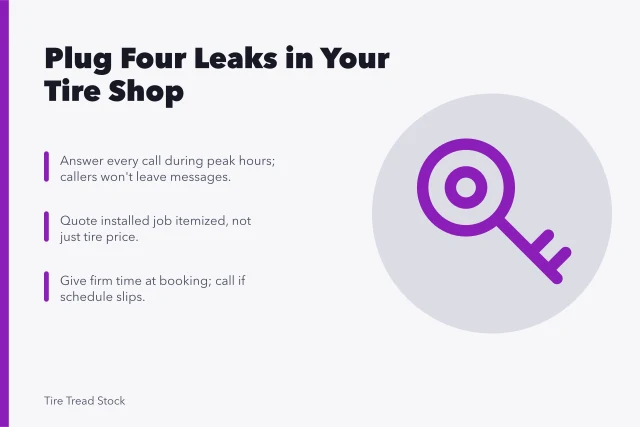
- First weather turnAnswer phone, give firm time
- Shoulder monthsFleet outreach, referrals
- Deep off-seasonMaintenance, alignment, inspections
- Before the changeover weeks. Contact your own storage and seasonal customers first and book them. They are the highest-return contacts you will make all year, and booking them early protects your capacity.
- At the first weather turn. Demand spikes suddenly. What matters here is that you can answer the phone and give a firm time, not that you have a campaign.
- In the shoulder months. This is where fleet outreach and referral relationships belong, because they are the work that fills quiet bays.
- In the deep off-season. Maintenance, alignment and inspection work, aimed at your existing customers rather than at new ones.
The general principle: sell scheduled work in advance, and in the spike weeks spend your effort on capacity rather than on demand you already have.
Reputation, handled honestly
Reviews decide which nearby shop gets called. The rule is absolute: do not pay for reviews, do not offer anything in exchange, do not filter which customers you ask, and do not write them yourself.
Honest review program
- Ask every customer the same way
- One link, one sentence
- Read job record before replying
- Fix the thing the review is about
- Never pay, filter or write reviews
The FTC's guidance for marketers on soliciting and paying for online reviews sets out what is expected and what is not permitted. Read it in full before anyone in your shop designs a review program.
What you can do is straightforward.
- Ask every customer, the same way, at the same point.
- Make it easyone link, one sentence.
- Respond to negative reviews by finding the job record and reading it before replying.
- Fix the thing the review is about. A pattern in your reviews is a pattern in your shop.
Reputation is downstream of the work. A shop with a comeback problem cannot market its way out of it, and the money spent trying would have been better spent on a calibration schedule.
Advertising claims
Anything you say in an advertisement has to be supportable. A price that implies a finished job must deliver one, and disclosures cannot hide in wording nobody reads. The FTC's advertising guidance for small businesses is the reference.
In this trade, installed-job pricing is more honest and more persuasive than quoting a tire price and pricing the work separately at the counter.
The customer who priced it online this morning
This is a permanent condition and it belongs in your marketing rather than in an argument at the counter.
Installed job vs box on doorstep
Installed job
- Tire
- Included
- Mounting
- Included
- Balancing
- Included
- Valve or sensor
- Included
- Torque to spec
- Included
- Old set disposal
- Included
- Comeback check
- Included
Box on doorstep
- Tire
- Customer supplies
- Mounting
- Not included
- Balancing
- Not included
- Valve or sensor
- Not included
- Torque to spec
- Not included
- Old set disposal
- Not included
- Comeback check
- Not included
Say plainly in your materials what an installed job includes: the tire, mounting, balancing, and valve or sensor service. It also covers torque to the vehicle manufacturer's specification, disposal of the old set, and a shop that will look again if something feels wrong.
That differs from a box on a doorstep. Stating the difference first beats defending it after a customer anchors on a number.
Decide in advance whether you fit customer-supplied tires, and publish the answer. Both positions are defensible; being unclear is not.
Measure per booked job
Impressions, clicks and followers cannot be put on a lift. Track two things.
Measure per booked job
- 2things to track
- Cost per booked jobby channel
- Booked jobsagainst capacity
Cost per booked job by channel. Ask every caller how they found you, record it, and divide the spend by the bookings. Most shops find that two channels produce almost everything and the rest are habits.
Booked jobs against capacity. Marketing that produces more demand than your bays can take is not a success. It converts into long waits, and long waits convert into the reviews you did not want. Growth in demand should be matched to growth in capacity, which makes the marketing question inseparable from the operating one.
Growth without breaking the shop
Three sequencing rules keep growth from turning into damage.
- Fix the comeback rate before increasing volume, because volume multiplies whatever your process does.
- Add capacity before demand, not after. A bay short of a technician is the same as no bay.
- Grow the scheduled share of the workstorage, fleets and seasonal bookings. Scheduled work is what lets a shop plan staffing instead of reacting to it.
Where marketing meets the rest of the business
Promise only what you can do, so menu decisions in the services and packages guide come first.
How the shop answers the phone and books the job is part of the flow in the operations and workflow guide, where most marketing spend is lost.
What you can say about price follows from the pricing and profit guide. What you may claim at all is partly a compliance question, mapped in the licensing and compliance guide.
Two capacity constraints sit behind all of it. Bay capability is set by the machines described in the equipment and setup guide, and the people who can use them unsupervised are the subject of the hiring and training guide.
Common questions
How much should a tire shop spend on marketing?
No page can give you a figure, because it depends on your capacity, your existing reputation and how well known you already are. Start from what a booked job is worth to you in contribution, work backward to what you can afford to pay for one, and let that set the budget.
Do I need a website?
You need somewhere that shows hours, location, services, and how to book, and that loads quickly on a phone. That can be a website or a well-maintained listing. What you do not need is a large site nobody updates.
Should I run price promotions?
Sparingly, and never on the goods alone. A promotion on an installed job in a shoulder month is a capacity-filling tool. A tire price promotion in a peak week gives away margin on work you would have had anyway.
What is the highest-return marketing activity?
Contacting your own past customers before a changeover season. They already trust you, they need the service, and the contact costs almost nothing. It requires records, which is the real reason most shops do not do it.
How long before marketing shows results?
Local search presence and reviews compound over months rather than days. Direct contact with past customers works immediately. Plan for both, and do not judge the slow one on a fast timescale.