Guides
Tire shop systems and KPIs for owners in 2027
What a tire shop system must actually hold: fitment and stock, bay time, vehicle history, storage locations, plus the KPI set and the security basics.
What to take away
- A tire shop system is judged on four data problems, and general service software usually solves only two of them.
- The four are fitment and stock by size, measured bay time, vehicle and service history, and storage location. The table below sets out each one.
- The system holds customer and payment data, which makes basic security part of running it rather than an extra project.
The four data problems
| Problem | What the system must do | Symptom when it cannot |
|---|---|---|
| Fitment and stock | Show what is on the rack, by size, at the moment of quoting | Bookings made for tires you do not have |
| Bay time | Record actual minutes per job, not menu minutes | Prices and slot lengths built on guesses |
| Vehicle and service history | Recall what was fitted, when, and what was declined | No seasonal outreach, and no context on a comeback |
| Storage location | Find a customer's stored set in about a minute | A storage room that becomes a search |
Most general service software handles invoicing and scheduling well and these four poorly. That is the gap to test for, because it is the gap that costs money in this specific trade.
Four data problems to test
Problem
- Fitment and stock
- Show rack stock by size
- Bay time
- Record actual minutes per job
- Vehicle history
- Recall fitted and declined work
- Storage location
- Find stored set in a minute
What the system must do
- Fitment and stock
- Bookings for tires you lack
- Bay time
- Prices built on guesses
- Vehicle history
- No seasonal outreach
- Storage location
- Storage room becomes a search
Symptom when it cannot
- Fitment and stock
- Bay time
- Vehicle history
- Storage location
Fitment is the hard one
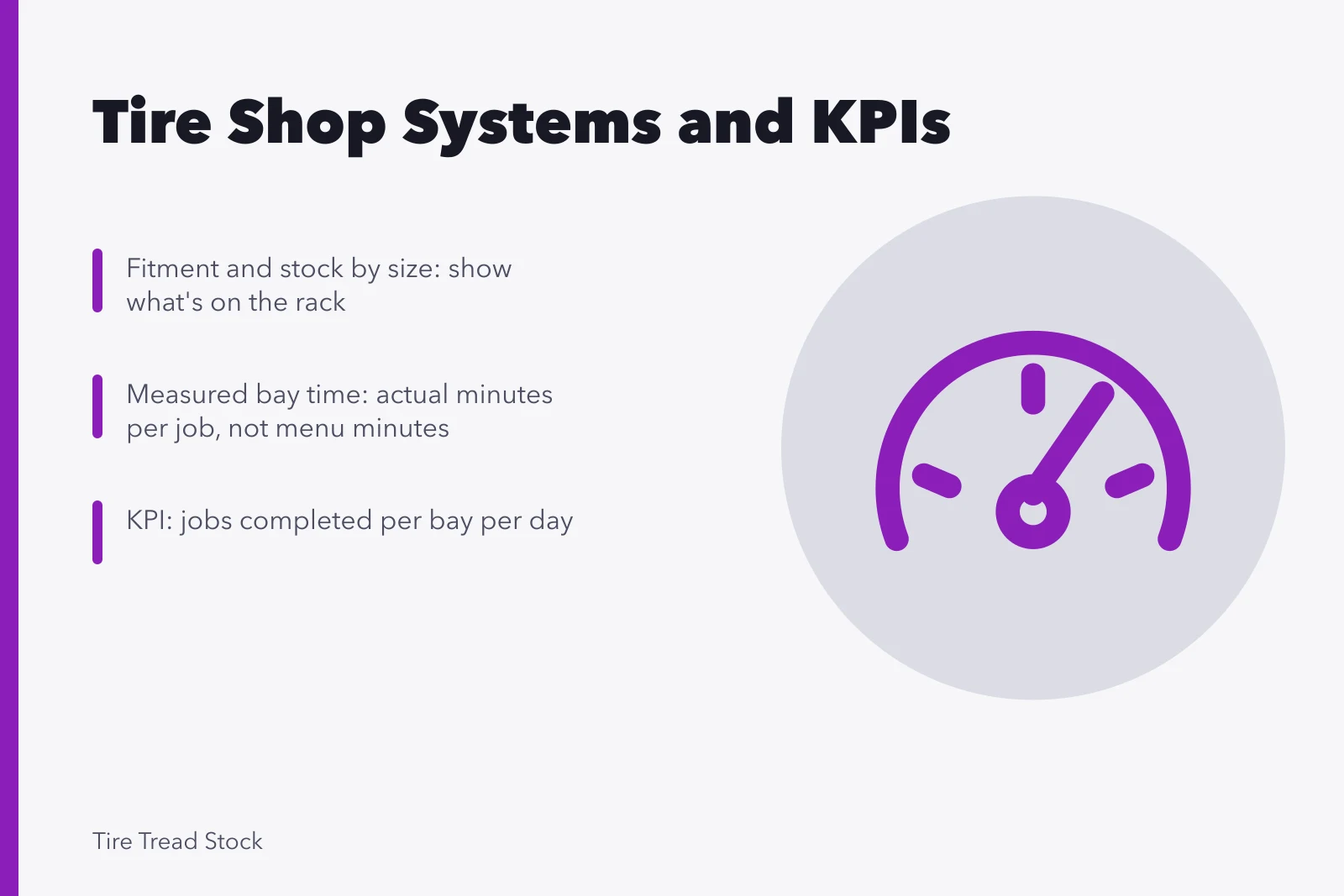
Tire fitment is unforgiving. There is no near-enough size, so the counter needs to know, while the customer is on the phone, whether the exact size is on the rack or on a confirmed delivery.
What that requires from a system:
- Stock held by size, updated when a tire leaves the rack rather than when the invoice is written.
- A way to reserve stock against a booking so two advisors cannot sell the same pair.
- Visibility of what is on order and when it lands.
- A miss recordwhen a size was needed and not available. This is the single most valuable report a tire shop can produce, and almost no system offers it as standard. A note field used consistently will do.
The KPI set
Keep it small. A shop that tracks twenty numbers looks at none of them.
Eight KPIs to track
- Jobs completed per bay per day
- Measured bay time by service
- Comeback minutes by service
- Miss rate
- Contribution per bay hour by service
- Attach rate
- Stock units by size and age
- Booked share of the week
Track these eight, no more:
- Jobs per bay per day.Completed jobs against bays open, and skip the weeks you were short staffed when you compare months.
- Measured bay time per job.Minutes the vehicle occupies the lift, not the menu time for the service. A four-tire mount and balance typically runs 30 to 45 minutes of bay time, and a four-wheel alignment 45 to 60 minutes. Those are typical ranges, so replace them with your own first.
- Comeback minutes.Time spent redoing work, as a share of total bay minutes. Set the threshold from your own records, and use one definition of what counts.
- Miss rate.The share of quotes where the exact size was not on the rack. Treat a rate above one in ten as a stock problem rather than a sales problem.
Numbers three and four are the ones shops skip and the ones that explain most of the difference between two shops with identical revenue.
- Contribution per bay hour by service.Price minus direct cost, divided by measured bay time.
- Attach rate on declined work.The share of declined recommendations that are later sold, measured within 90 days.
- Rack accuracy.System stock against a weekly physical spot count, stated as a percentage.
- Repeat customer share.Customers with a second visit within 12 months.
Definitions before dashboards
Write the formula and the data source for each number before you build any report. Two people counting a comeback differently produce a trend that means nothing.
Define KPI edges first
Is a torque recheck a comeback?
count as comeback
count as new job
Be specific about the edges. Is a torque recheck a comeback? Is a customer who declined work and returned a month later an attach or a new job? Does bay time start when the car enters the lot or when it occupies the lift? None of these has a correct answer, and all of them need a consistent one.
What the system has to hold for compliance
Some records exist because a rule requires them rather than because you find them useful.
Compliance records to hold
- Job recordsauthorized and done
- Waste tire quantities and pickups
- Fee collection and remittance
- Employment hours and pay
- Tire registration and recall handling
The general expectation for business records, that they clearly show income and expenses and support what was bought and sold, is set out in the IRS guidance on what records a business should keep.
According to the IRS, keep records that support a return for at least three years after the return is filed. Employment tax records are expected to be kept for at least four years after the tax is due or paid. Tire registration and recall records follow the manufacturer and NHTSA rules, so confirm the period your brands require.
Security is part of running it
The system holds customer names, vehicles, contact details and payment activity. That makes it a target, and a small shop is not too small to be one.
The basics are documented and free to read. The NIST small business quick-start guides set out an approachable version of the fundamentals, and the CISA resources for small and medium businesses cover practical steps and current advisories.
The short version for a shop:
- Individual accounts, never a shared login on the counter machine.
- Multi-factor authentication wherever it is offered, especially on email and anything financial.
- Permissions by role, so a seasonal hire cannot export the customer list.
- Backups you have actually restored from once, rather than backups you assume work.
- A plan for what happens when the system is down on a Saturday, written before it happens.
Buy for the constraint, not the feature list
Software should be judged the way equipment is: does it add sellable bay minutes or prevent a loss?
A system that lets the counter confirm stock in ten seconds adds minutes. A system that records bay time automatically adds accuracy to your prices. A system with a large feature list nobody uses adds a subscription. Run any candidate against the four data problems above, with your own records, before signing anything.
This guide names no products or vendors. The categories you will compare are tire shop point of sale and inventory systems, general service shop software with a tire module, standalone stock tools, and the rack sheet.
Costs are quoted per user or per bay per month, so a headline price means little until you know the user count and which modules are included.
Apply two more tests to any system you consider. Can you get all your data out in a format you can open, without asking anyone for help?
What still works on a Saturday morning when the connection is down? A shop that cannot answer both questions has not finished evaluating the system, whatever the demonstration looked like.
How the system connects to the shop
The flow the software has to support, from inquiry through follow-up, is set out in the operations and workflow guide. The prices and measured bay times it stores come from the pricing and profit guide. The customer records that make seasonal outreach possible are what powers the work in the marketing and growth guide.
Three other threads. Permission structures and training on the system belong with the crew development in the hiring and training guide. Compliance records sit inside the wider regulatory map in the licensing and compliance guide. And bay time data is only as good as the machines and layout producing it, which is covered in the equipment and setup guide.
Common questions
Can a small shop run on paper?
Yes, and many do well. The four data problems can all be solved with a whiteboard, a rack sheet and a card file, provided somebody keeps them current. Software helps when volume makes paper slow, but it will not fix a shop that never kept the records at all.
What matters most in a system?
Stock visibility at the moment of quoting. Everything else has a manual workaround that costs minutes; that one costs you the job and the customer's afternoon.
How many KPIs should we track?
The eight above are already more than most shops sustain. Start with jobs per bay per day, comeback minutes and miss rate, and add the others once those three are reliable.
Should the system be cloud based?
Either can work. What matters is that you can get your own data out in a usable form, that it is backed up somewhere you control, and that you know what happens when the internet is down during a changeover week.
How do we handle a recall?
Know in advance how you would find the affected customers in your records, because that is the question a recall actually asks. Test it once with a hypothetical size and see whether the answer takes minutes or days.