Guides
Getting tire shop expansion right the first time
Tire shop expansion decided properly: whether the first shop is actually full, the four ways to grow, and how to read a second trade area before signing.
What to take away
- Answer one question before any otheris the first shop actually at capacity, or just busy? They are different, and only one justifies a second site.
- There are four ways to grow and only one of them is a second location. The other three are cheaper and reversible.
- A second site inherits none of the first one's advantages. Not the reputation, not the crew, not the referral network, not the permits.
- Read a trade area by counting what drives past, not by reading a market report about the county.
- The constraint that limits a second site is almost always a person, not a building.
First: is the shop full, or just busy?
Busy is a feeling. Full is a number.
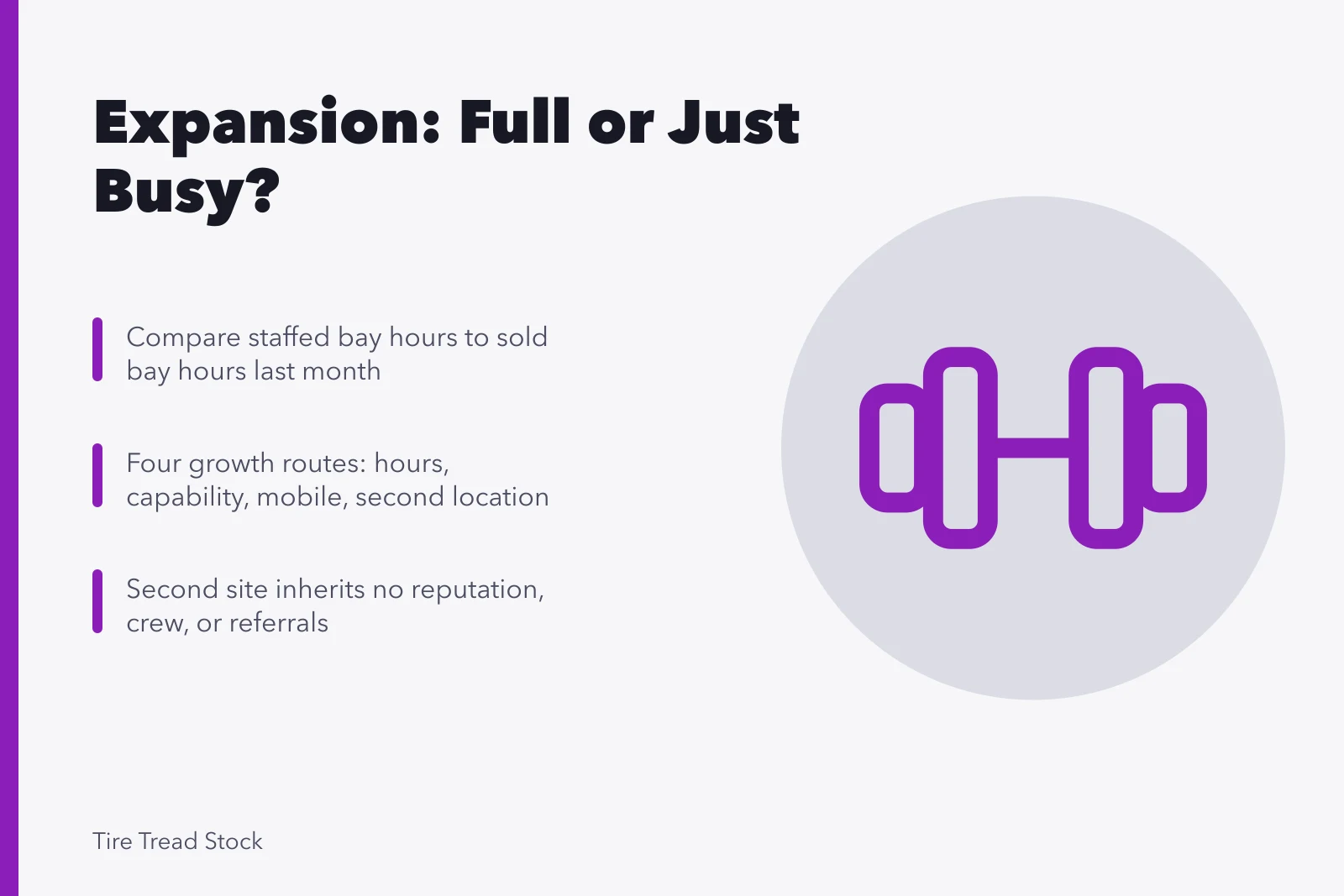
Take the bays you can staff on a normal day, multiply by productive hours, and compare that against the bay hours you actually sold last month. If there is a meaningful gap, the shop is not full, and a second location will not fix whatever is producing the gap. It will reproduce it somewhere else with new rent attached.
A worked example. Four bays staffed eight hours a day, six days a week is 192 bay hours a week. Sell 150 of those hours and the shop is at about 78 percent, with roughly 40 bay hours a week unsold. A reasonable planning threshold is about 85 percent of staffed hours on normal days.
Below that, the gap is internal and a second site would inherit it.
The common gaps and what they mean:
Busy vs. Full: Diagnose the Gap
Symptom
- Idle bay time with demand
- Scheduling or staffing problem
- Long waits with idle bays
- Scheduling problem
- Comeback minutes eating capacity
- Process or equipment problem
- Turning away work you cannot do
- Capability gap
What it means
- Idle bay time with demand
- Long waits with idle bays
- Comeback minutes eating capacity
- Turning away work you cannot do
Only a shop that is genuinely full, with demand it is refusing and no internal fix available, has an expansion question.
The four ways to grow
What it costs
- More hours or days
- Labor and some fixed cost
- More capability in the same building
- A machine and training
- Mobile or on-site service
- A vehicle, tooling, insurance
- A second location
- Everything again, from zero
What it risks
- More hours or days
- Crew fatigue, thin evening demand
- More capability in the same building
- Buying equipment for work that does not arrive
- Mobile or on-site service
- Quality off-site, and torque discipline in a parking lot
- A second location
- All of it
Reversible?
- More hours or days
- Yes, quickly
- More capability in the same building
- Partly
- Mobile or on-site service
- Mostly
- A second location
- Barely
Work down the list. Most shops that believe they need a second site actually need the second or third row, and those can be tested in a season rather than committed to for years.
Four Growth Routes Compared
Route
- More hours or days
- Labor, fixed cost
- More capability in building
- Machine, training
- Mobile or on-site service
- Vehicle, tooling, insurance
- A second location
- Everything again
Cost
- More hours or days
- Crew fatigue
- More capability in building
- Equipment for no work
- Mobile or on-site service
- Off-site quality
- A second location
- All of it
Risk
- More hours or days
- Yes, quickly
- More capability in building
- Partly
- Mobile or on-site service
- Mostly
- A second location
- Barely
Reversible?
- More hours or days
- More capability in building
- Mobile or on-site service
- A second location
Reading a second trade area
If a second site is genuinely the answer, read the area the way you should have read the first one: by counting, not by reading a report about the county.
Read the Second Trade Area
- Count vehicle mix at commuting hour, twice
- Check road surface for wear patterns
- Map fleets within short drive
- Map competitor refusals
- Confirm distributor supply and timing
- Check local zoning, waste, permits
- Vehicle mix.Stand on the roads that would feed the site at commuting hour and count. Sedans, small crossovers, full-size pickups, work vans, larger SUVs. Do it twice, on different days. That count writes your size list.
- Road surface.Potholed arterials, construction routes and unfinished shoulders produce sidewall damage and bent wheels. Smooth suburban roads produce slower wear-out replacement.
- Fleets.Contractor vans, delivery vehicles and municipal trucks within a short drive are schedulable work for quiet days.
- Competitor refusals.Map the nearby shops by what they will not do: no large truck tires, no low-profile wheels, closed at five. Each refusal is an opening.
- Supply.Which distributors deliver to that address, how often, and by when. A slower route means more stock, which means more capital in a site that has not proven itself.
- Rules.Zoning, waste tire storage and permits are set locally and do not transfer from your first site. Assume nothing.
The SBA's business guide covers how market research fits with the licensing and financing steps a second site triggers, most of which you will be doing again from the beginning.
What does not transfer
This is where second locations fail, and it is predictable.
What Does Not Transfer
- Reputation stays with the first building
- Crew cannot staff two shops
- Referral network is local to site one
- Permits and rules differ by town
- Owner attention is the largest loss
Reputation. Yours is local and it is attached to a building and a set of people. The new area has never heard of you.
The crew. You cannot staff two shops with one good team.
The referral network. The other shops who send you work are near your first site and refer to shops near them.
Permits and rules. A different town, sometimes a different county, with its own zoning, waste and signage requirements.
Your attention. A shop that has never run without the owner present will not learn to on the week you are somewhere else.
The person problem
The binding constraint on a second location is almost never the building. It is whether you have a senior technician or manager who can run a shop to your standard without you in it.
Do You Have a Stand-In Manager?
Can a senior tech run the shop without you?
Test with two weeks away
Develop one first, takes a year
If that person does not exist yet, the expansion project begins with developing one, and that takes a year rather than a quarter. Test it before you commit: leave the first shop entirely for two weeks and see what the comeback rate, the schedule and the counter look like when you return.
Staffing the second site is a hiring problem in a market you do not know, so check what pay looks like there rather than assuming your own numbers travel. Published local data in the Bureau of Labor Statistics occupational tables gives estimates by occupation and metropolitan area, which is a defensible reference for that comparison.
Staging a second site
If everything above holds, stage it rather than opening at full width.
Staging a Second Site
- Confirm permitted use and waste storage
- Confirm supply to the address
- Open on base fitment work only
- Staff with one existing crew member
- Run same records from day one
- Add services when miss log proves demand
Use typical ranges for planning, because only a local quote is real. Lease runs about $10 to $30 per square foot per year on a triple net basis. Buildout and equipment for two to four bays lands in the low to mid six figures.
Working capital is two to three months of payroll plus the opening tire order. What moves those numbers is bay count, whether the space was already a shop, and how much stock the local distributor routes force you to carry.
A staged opening usually takes nine to twelve months, mostly lease negotiation, permits and buildout, with the ramp running six to twelve months past opening.
Note that the size list may differ from your first shop, because the vehicles are different. The fitment questions behind that, sizing, load and speed markings, aging, registration and recall handling, sit with the vehicle and tire manufacturers and with the federal tire safety guidance, and they should be checked rather than carried over by habit.
In practice the opening size list comes from the count at the new site, not from the shelf at the first one. More pickups and work vans means more light truck sizes in load range E and fewer 17 inch passenger sizes.
Stock the first month from the miss log, since a slower distributor route forces more depth on fewer sizes.
Checklist before signing
- Confirm the first shop holds at or above the threshold on normal days, not just at month end.
- Name the manager before you sign anything, and run the two week absence test first.
- Keep the lease, buildout and working capital money in cash, not in the same line of credit that funds stock.
- Build the opening size list from the new trade area count, and stock the first month from the miss log.
- Put the first shop's standards in writing, because the new site will be run by someone else.
Expansion is a decision about capacity, which starts with the flow described in the operations and workflow guide and the machines in the equipment and setup guide. Whether the economics work at a second site is the arithmetic in the pricing and profit guide, applied to a different rent and a different labor cost.
The manager who makes it possible comes out of the hiring and training guide. Building a reputation in a new area from zero is the work described in the marketing and growth guide. And the permits, waste rules and registrations all have to be redone, which is mapped in the licensing and compliance guide.
Common questions
How do I know when the first shop is genuinely full?
When sold bay hours are close to available bay hours on normal days, comeback minutes are low, and you are refusing work you have the capability to do. Anything short of that is a gap to close before you grow.
Is buying an existing shop safer than opening one?
It is different rather than safer. You buy a customer base, a location and a crew, and you also buy their reputation, their equipment condition and any compliance history. Verify the last three carefully, because they are the parts that are easy to describe well and expensive to inherit.
How far apart should two locations be?
Far enough that they are not competing for the same cars, close enough that you can be at either within a reasonable drive. The second constraint binds more often than the first in the early years.
Should the second shop use the same prices?
Only if its rent, labor cost and bay count are the same, which they will not be. Run the pricing arithmetic separately for each site.
What is the most common reason a second location fails?
The owner's attention. Two shops need a manager at one of them, and hiring that person after signing the lease is the wrong order.