Guides
Tire shop staff training, as a checklist
A training plan for a new tire shop hire, built as capability stages with sign-offs: what each stage covers, what proves it, and what stays supervised.
What to take away
- Train in capability stages, each ending in a demonstration signed by name. Time served proves nothing.
- Stage one is safety and handling, not tire work. Nobody touches a customer's wheel in the first days.
- Every stage adds exactly one class of decision. Adding two at once is how habits get skipped.
- Repair judgment is the last thing to release, because it carries the most liability.
- Keep the training record. It is evidence of competence and it tells you where your shop's capacity actually is.
How the plan is structured
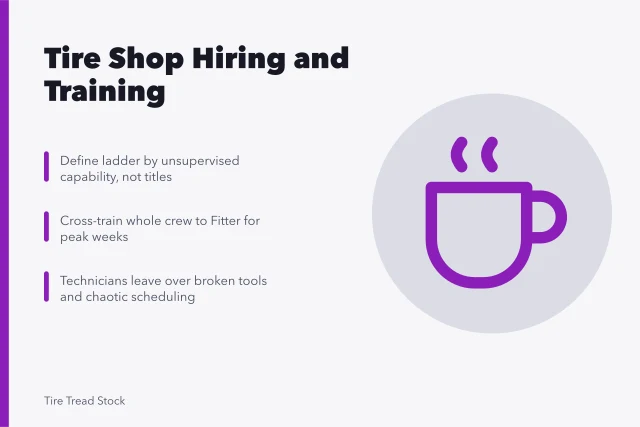
Five stages, each defined by what the person can do without being checked. Nobody moves up on a schedule. They move when the demonstration is passed and signed.
Write the sign-off with the date, the task and the name of whoever observed it. That record is what your quality sampling, your insurance submission and your schedule all draw on.
Stage 1: safety, handling and the shop's habits
Covers the environment before it covers the work.
Stage 1 safety sign-off items
- Lift operation and pre-use check
- Out-of-service tagging, no permission needed
- Protective equipmentwhat, where, when
- Chemical and dust handling and disposal
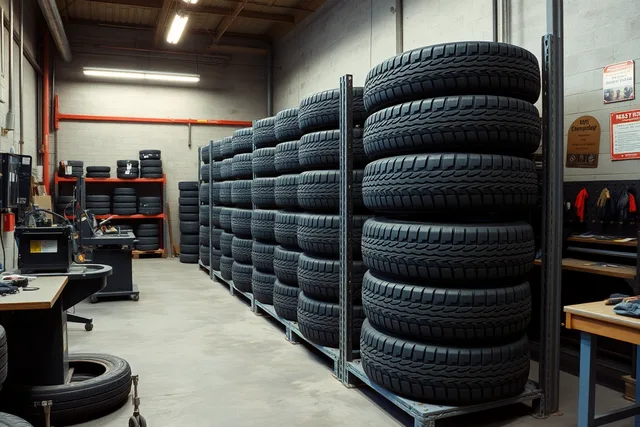
- Waste tire stacking and quantity
- Walking routes around raised vehicles
- Staging and labeling a booked set
Build this stage from the hazard categories a tire shop actually carries: lifting equipment, chemicals and solvents, dusts, noise, cutting tools and slippery walking surfaces. Using that list rather than a generic induction keeps the stage short and specific.
Demonstration: a full day of staging, breakdown and waste handling with no prompting on safety.
Stage 2: documentation before the work
The habits that prevent disputes come before the ones that produce revenue.
- Recording vehicle, fitted size and specification from the vehicle rather than from the customer.
- Photographing wheel condition on all four corners before anything moves.
- Identifying and noting existing damage, and how to show it to a customer plainly.
- Locating and recording locking fastener keys.
- Reading a work order and confirming the tire against it before the wheel comes off.
Demonstration: ten consecutive check-ins with complete records and photographs, verified by whoever samples finished work.
Stage 3: standard fitment
Now the actual work, on straightforward jobs only.
Standard fitment sequence
- Mount and dismount without marking the wheel
- Balance and read the result
- Service the valve
- Set pressures to manufacturer specification
- Torque to specification with calibrated tooling
- Verify as a separate signed step
- Clear the bay and return tools
Demonstration: a supervised week of standard fitments with no comebacks attributed and no documentation gaps.
Stage 4: the difficult cases
This stage is where the wide time spreads live, and where a shop's bottleneck usually sits.
- Large-diameter and low-profile fitments without wheel damage.
- Tire pressure sensorshandling, replacement, relearn, and confirming function before the vehicle is lowered.
- Seized and broken hardwarewhen to stop and hand the conversation to the counter.
- Vehicles the shop sees rarely, worked slowly and timed.
- The stop, show, quote, proceed sequence, practiced out loud.
That last item is a trained skill and it fails under pressure if it has never been rehearsed. Practice it when the shop is quiet so it survives a Saturday.
Demonstration: difficult jobs completed unsupervised, with at least one real stop-show-quote handled correctly.
Stage 5: repair judgment, released last
The final capability, and the one that carries the most liability.
- Reading the shop's written repair refusal policy and knowing where it came from: the tire manufacturer's own instructions and published industry repair guidance.
- Assessing damage against that policy and reaching a binary answer.
- Explaining a refusal to a customer who does not want to hear it, without negotiating the answer.
- Recognizing when a question belongs to a senior technician or the owner.
- Knowing where current sizing, marking, aging, registration and recall guidance lives, at the vehicle and tire manufacturers and the federal tire safety pages, and that it is checked rather than remembered.
Demonstration: a quarter of repair decisions reviewed against the policy with no drift in either direction.
What stays supervised regardless
Some things do not graduate.
- Any casing where the policy is unclear. The answer is escalation, not judgment.
- Any vehicle outside the classes the shop has decided to accept.
- Any job where the customer is disputing the findings.
- Anything involving a recall notice.
Write these down. A list of things that always escalate is more useful than a general instruction to use judgment.
Keeping the record and using it
The training record is not filing. It tells you which rungs your shop actually has, which your schedule depends on, and it is the first place to look when your quality sampling shows a pattern.
Keep it with the other employment records, following rules on what to keep and its form.
The Department of Labor's resources for new and small businesses covers the federal side of recordkeeping and hours; your state adds its own. Training and progression decisions also face nondiscrimination requirements; the EEOC's small business resource center is the reference for those.
Where pay sits against each rung is a separate calculation, and published local data in the Bureau of Labor Statistics occupational tables is a defensible reference for setting it.
How the plan connects to the shop
The rungs this plan advances through are defined in the hiring and training guide, and the process that brought the person in is in the piece on hiring reliable bay staff. Stages three and four depend on which machines you run and how the bay is laid out, covered in the equipment and setup guide.
Some stage-one content exists because a rule requires it, and the map of those rules is in the licensing and compliance guide. How many people you are training toward depends on demand, developed in the market and expansion guide.
Common questions
How long should each stage take?
As long as the demonstration takes to pass, which varies by person and by how much varied work the shop sees. Putting a fixed number of weeks on a stage converts a competence test into a waiting period.
Can stages overlap?
Slightly, and carefully. Documentation habits from stage two should be practiced throughout. What should not overlap is releasing two new classes of decision at once, because that is when a habit gets skipped and nobody notices.
Who signs off?
Whoever observed the demonstration, by name, with the date. In a small shop that is usually the owner or the senior technician, and it should not be the trainee.
What if someone stalls at a stage?
Find out which specific task is failing rather than concluding the person is not suited. Most stalls are one task, and most of those are a step nobody explained clearly.
Does this replace formal training?
No. Where a certification is genuinely required for work you perform, it is required regardless. This plan is about what the shop can safely release a person to do unsupervised, which is a different question.