Guides
Tire shop compliance checklist: every item, with the reason behind it
A tire shop compliance checklist arranged as a calendar: what to confirm before opening, what to check daily and monthly, and what to review each year.
What to take away
- Compliance for a tire shop is mostly a calendar problem. The one-time approvals are the easy half.
- The daily items are short by design. A check that takes five minutes gets done; one that takes an hour does not.
- Waste tire volume, lift inspection and torque tool calibration are the three recurring items shops most often let slip.
- Keep one file of answers, each with the office, the person and the date. It is the record that proves the work was done.
Tire shop compliance checklist is jurisdiction-agnostic by design. It names federal references where they apply and leaves state and local specifics to the office that owns them. The absence of state-by-state detail is intentional, not a gap.
Before you open
Before you open: confirm these
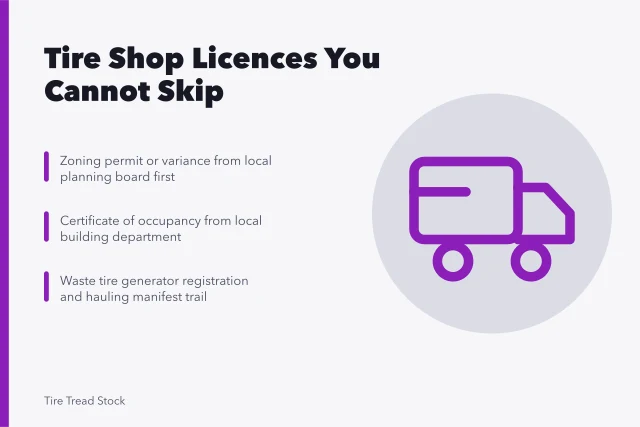
- Zoningautomotive service permitted, parcel ID
- Building and occupancy approvals, lift included
- Sign permit issued separately
- State registration for service or waste tires
- Waste tire duties in writing
- Insurance bound, policy documents on file
- Written confirmation that automotive service is permitted at this parcel, with the parcel identifier on it.
- Building and occupancy approvals complete, including anything required for the lift installation.
- Sign permit issued, separately from the building permit.
- Business entity and tax accounts registered with the state.
- Any state-level registration for automotive service, tire retail or waste tire generation confirmed or confirmed as not required.
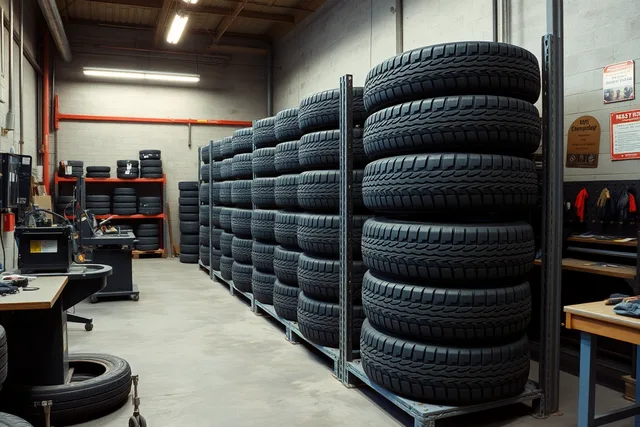
- Waste tire duties in writing from the environmental agencystorage limits, storage form, permitted haulers, records required. A sample permit limit is 1,000 tires on site at any time; your state sets the number that applies to you.
- Hauler contracted, with a documented pickup schedule.
- Invoice format set up to disclose any required fee exactly as the rule specifies. State waste tire fees are typically a fixed charge per tire, often in the low single dollars. The exact fee and wording come from your state.
- Insurance bound, with the policy documents on file rather than the certificate alone.
- Accessibility of parking, entrance, counter and restroom reviewed against current requirements.
- Employment obligations set up before the first hireclassification, records, postings.
- Written repair refusal policy, drawn from the manufacturers' instructions and published industry repair guidance.
- Written tire registration and recall handling procedure. The tire registration rule is 49 CFR Part 574, which requires dealers to offer registration forms to purchasers.
- Manufacturers' operating and maintenance instructions on file for every machine.
Daily, and short enough to actually happen
- Lift pre-use checkarms, locks, air, visible damage. Initialed. The check list comes from the lift manufacturer and ANSI/ALI ALOIM, not from a generic form.
- Machine guards in place and no out-of-service tag ignored. General machine guarding is 29 CFR 1910.212.
- Walkways clear and no standing water. Falls are the injury a tire shop most reliably produces.
- Personal protective equipment present at the point of use, not in a cupboard. PPE selection and use are covered by 29 CFR 1910.132.
- Waste tire area within its limit and stacked as required.
- Torque tooling accounted for and in use. An impact gun standing in for a torque wrench is a comeback in preparation. Torque specs come from the vehicle manufacturer's service information, not from the tire sidewall or a generic chart.
Weekly
Weekly compliance tasks
- Waste tire count against storage limit
- Next pickup date confirmed
- Manifests filed for the week's pickups
- Incidents and damage claims written up fresh
- Job records complete, inspection findings shown
- Waste tire count reconciled against the storage limit on the permit.
- Hauler manifests checked against the pickup log. Request any missing manifest the same week.
- Torque wrench calibration due dates checked. Any tool out of tolerance is removed from service until recalibrated.
- Job files completetorque spec source noted, repair refusals documented, tire registration forms offered under 49 CFR Part 574.
- Incident and near-miss reports filed, including any injury that may become an OSHA 300 log entry under 29 CFR 1904.
Monthly
- Machine maintenance performed to the manufacturers' schedules, recorded.
- Calibration checks due this month completed, particularly torque tooling and the balancer. A typical torque wrench check records readings at three points across the tool's range.
- Comeback rate reviewed by service. A rise in vibration complaints is usually a machine before it is a person.
- Payroll records, hours and classifications reviewed for anything that has drifted.
- Fee collection reconciled and remitted as required.
- New staff trained and recorded before they operate anything on their own.
Annually, or when something changes
- Every license and permit checked for expiry, with renewal dates on a calendar.
- The written answers file re-verified with each office. Rules move and nobody will notify you.
- Repair refusal policy compared against current manufacturer instructions and industry guidance.
- Recall handling procedure checked against current federal guidance at NHTSA's tire safety pages, which cover sizing, markings, aging, registration and recalls.
- Safety program reviewed against the hazard categories OSHA documents for automotive repair and refinishing work: chemicals, dusts, noise, lifting equipment, cutting tools and slippery surfaces. Relevant standards include 29 CFR 1910 Subpart D for walking-working surfaces, Subpart O for machine guarding, and 29 CFR 1910.132 for PPE.
- Accessibility re-checked, especially after any change to parking, entrance or counter layout. The Department of Justice's ADA guide for small businesses is a plain-language reference for what to look at.
- Insurance reviewed against how the business has actually changed: new services, more vehicles, higher-value wheels, added storage.
The triggers that reset the calendar
Some events invalidate part of the file immediately. Treat each as a reason to re-run the relevant section rather than waiting for the annual review.
- Adding a service, especially one involving new equipment or a different class of vehicle. Adding light truck tire repair, for example, may require a higher lift capacity and a different torque spec source.
- Hiring the first employee, or the first employee in a new state.
- Moving, expanding or taking additional storage space.
- Any enforcement contact, inspection or complaint, whatever the outcome.
- A recall affecting a tire you sell or have sold.
- A change of insurer or a change of program administrator for road hazard claims.
Keeping the record
One file, one place, every answer with the office, the person, the date and any reference number. It should be findable by someone who is not you, because the value of the file is highest on the day you are not there.
Each record row needs: item, authority, office, contact person, date confirmed, reference number, review date, document location, and owner.
Which authority governs what, and where to find answers, is in the licensing and compliance guide. The specific call sequence is in the piece on working out which licenses apply.
Coverage decisions alongside these obligations are in the insurance guide. Maintenance and installation duties attached to machines are in the equipment and setup guide.
Common questions
Is a checklist like this enough on its own?
No. It is a prompt list, not a statement of requirements. Every item has to be filled in with what your jurisdiction actually says, and that comes from the offices rather than from any page.
Who should own the daily items?
Whoever opens the shop. A daily check owned by the owner is a daily check that stops when the owner is away, which is the day it matters.
What happens if we miss a waste tire pickup?
The pile grows past whatever limit applies and becomes visible. Have a second hauler contact on file, and escalate on the first missed collection rather than the third.
How detailed should incident records be?
Detailed enough that someone reconstructing it in a year understands what happened: date, vehicle, people present, what was observed, what was done, and what was communicated to the customer. Write it the same day.
Do we need a compliance officer?
A small shop needs a named person, not a role. What matters is that one person is accountable for the calendar and the file, and that the accountability survives their vacation.