Guides
Which licences a tire shop cannot skip for owner-operators
A tire shop licence list for owner-operators comes from six offices, not one page. Here are the calls, the questions, and the record that proves you asked.
What to take away
- Six offices issue the licenses a tire shop cannot skip. The local planning board, the building department, the state business registry, the environmental agency, and OSHA or a state-plan equivalent handle the first five. The sixth office covers public accommodation.
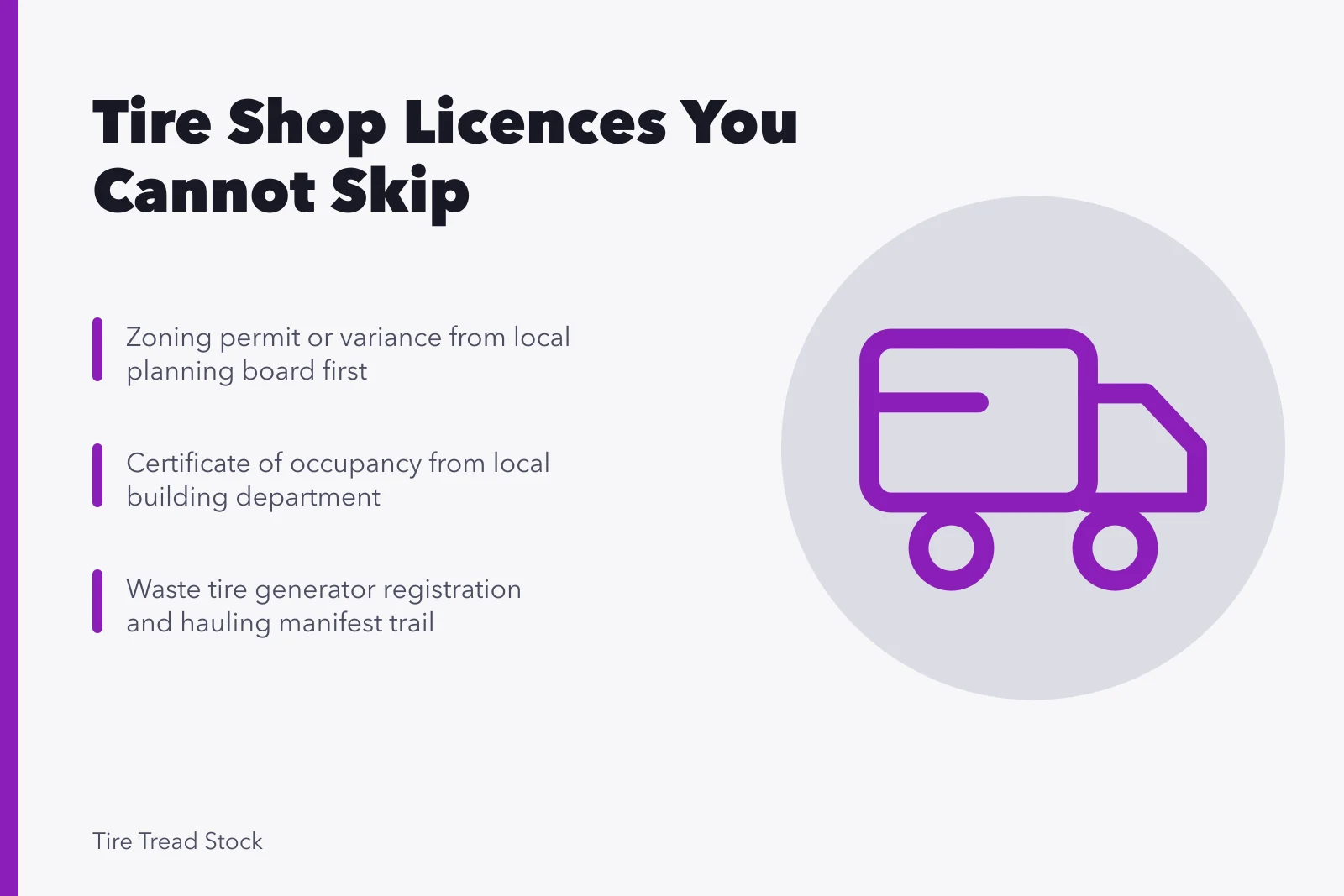
- The named papers start with a zoning permit or special use variance, a certificate of occupancy, an LLC registration, and an assumed name filing. Then come the sales tax permit, the waste tire generator registration, and an EPA ID number if you pour spent solvent.
- Zoning goes first. A refusal there makes every later answer irrelevant.
- Close every call with one questionwhat else do I need that your office does not issue?
- Log the office, the person, the date, the answer, and any reference number in one file, then set a review date on it.
The documents, by name
A tire shop license list is not one document. It is a stack assembled from separate offices, and the stack differs by parcel, not just by state. A Texas sales tax permit and a Florida waste tire registration never arrive in the same envelope.
Licenses by Issuing Office
Document
- Zoning permit
- Local planning board
- Certificate of occupancy
- Building department
- LLC registration
- Secretary of State
- Sales tax permit
- State revenue dept.
- Waste tire registration
- State environmental agency
- Scrap tire fee account
- State revenue/env agency
Issuer
- Zoning permit
- Allows service and storage
- Certificate of occupancy
- Legal for service work
- LLC registration
- Registers entity and trade name
- Sales tax permit
- Required before invoicing sales
- Waste tire registration
- Casing enters regulated stream
- Scrap tire fee account
- Collects per-tire fee
Why Needed
- Zoning permit
- Certificate of occupancy
- LLC registration
- Sales tax permit
- Waste tire registration
- Scrap tire fee account
| Document | Who issues it | Why a tire shop needs it |
|---|---|---|
| Zoning permit or special use variance | Local planning board or board of adjustment | Confirms automotive service and outdoor casing storage are allowed on that parcel |
| Certificate of occupancy | Local building department | Certifies the building is legal for service work, not just storage, and a change of use needs a new one |
| LLC or corporation registration, plus assumed name filing | Secretary of State, or the county clerk for a DBA | Registers the entity and the trade name on the sign. Filing fees typically run $50 to $500 |
| Sales tax permit | State department of revenue, such as the Texas Comptroller or the Florida Department of Revenue | Required before you invoice a tire sale. Texas issues it at no charge |
| Waste tire generator registration, or scrap tire site registration | State environmental agency, such as Florida's DEP or the Texas TCEQ | Every casing you remove enters a regulated stream and counts against a storage limit |
| Scrap tire fee account | State revenue or environmental agency | Florida collects $1.00 per new tire sold, Texas about $2.00. The fee is a line item on the invoice |
| Hazardous waste EPA ID number (Form 8700-12) | EPA, or the state agency that runs RCRA | Applies once you pass generator thresholds. A very small quantity generator stays under 100 kg (220 lb) a month |
| Hazard communication program and rim wheel training records | Federal OSHA or a state-plan agency | 29 CFR 1910.1200 covers solvents and safety data sheets; 29 CFR 1910.177 covers rim wheel service |
| Accessible design compliance at buildout | Local building official, under the 2010 ADA Standards | Parking, entrances, counters, and restrooms are cheaper to fix before the walls close |
Two of these carry a physical consequence. The waste tire registration attaches to a pile that is visible from the road. The certificate of occupancy attaches to a building you cannot legally open.
Call 1: the zoning permit or special use variance
Ask before you sign the lease, because this answer can end the project. Bring the parcel identifier and use it: a general answer about a street is not an answer about a lot.
Zoning Call Questions
- Is automotive service permitted by right?
- Does permission cover tire sales?
- Is outdoor casing storage allowed?
- What does change of use require?
- What parking, access, signage rules apply?
- What else does your office not issue?
A special use or conditional use approval usually means a public hearing with mailed notice to neighbors. Expect four to six weeks from filing to decision, and more if plan review or a variance is added.
Call 2: building permits and the certificate of occupancy
Building permits and certificate of occupancy
- Occupancy, and any change-of-occupancy requirement.
- Building permits for the buildout, especially the slab, ventilation, and drainage.
- Lift installation. Some jurisdictions require a permit or an inspection for it.
- Sign permits, which are separate and often forgotten until the sign is fabricated.
- A local business tax receipt or occupational license, issued by some cities after zoning, fire, and building sign off.
- Hours of operation, if the site sits near residential use.
Ask whether plan review is required before work starts. Finding out after the concrete is poured is the expensive version. Permit fees are usually set as a share of construction value, so a $200,000 buildout commonly carries several thousand dollars in fees.
Building Permit Checklist
- Occupancy and change-of-occupancy
- Building permits for slab, ventilation, drainage
- Lift installation permit or inspection
- Sign permits, often forgotten
- Local business tax receipt
- Hours of operation if near residences
Call 3: state business registry and sales tax permit
State business registry and sales tax permit
- Entity registration, and the assumed name filing if you trade under a different name.
- Sales tax account, since you sell goods as well as labor.
- Whether the state licenses automotive service businesses, tire retailers, or waste tire generators as a category.
- Whether any individual in the shop needs a personal certification for the work you intend to perform.
Entity filing fees typically run $50 to $500. Delaware's minimum is $110 and Texas charges $300. A Texas sales tax permit costs nothing, while a few states charge a small application fee.
State Registry Questions
- Entity registration and assumed name filing
- Sales tax account for goods and labor
- State licensing of service or tire retailers
- Personal certification for technicians
Ask that last question plainly. Some states regulate specific automotive work at the technician level rather than the business level, and the answer changes who you can hire.
Call 4: waste tire registration and the environmental agency
This is the call people skip. Every casing you remove enters a regulated waste stream in most jurisdictions. Florida's Department of Environmental Protection registers waste tire sites and collectors, and Texas requires transporters to register with the TCEQ.
Waste Tire Agency Questions
- Registration duties as a generator
- On-site storage limits and methods
- Permitted haulers and load records
- Fee collection on new tire sales
- Contact if hauler fails to collect
Scrap tire fees typically run $1 to $2 per new tire sold: Florida charges $1.00, Texas about $2.00, California $1.75. Confirm the current rate and any size exceptions before you print an invoice.
Many states cap how many casings you may hold on site. A manifest, sometimes called a trip ticket, must travel with every load.
Get this in writing. It is the requirement with a physical pile attached.
Call 5: workplace safety
The hazards are knowable in advance even where the paperwork is not. OSHA's overview of hazards in automotive repair and refinishing sets out what a shop contends with:
Workplace safety
- solvents
- dusts
- noise
- lifting equipment
- cutting tools
- slick floors
Two standards land on tire work directly. 29 CFR 1910.1200 requires a written hazard communication program and safety data sheets for the solvents on your shelf. 29 CFR 1910.177 covers rim wheel service, including training and a restraining device.
Ask which standards and recordkeeping obligations apply to a business of your size, and whether your state runs its own program with additional requirements. About 22 states run OSHA-approved plans that cover private employers.
Write the procedures for lift use, machine authorization, and maintenance while the shop is still empty.
Anything involving torque, inflation, or repair belongs to the tire manufacturer's published specifications and to Transport Canada and CSA standards, not to a shop's own guess.
Call 6: accessibility and customer-facing rules
A shop with a waiting area and a parking lot is generally a place of public accommodation. The Department of Justice's ADA guide for small businesses covers parking, entrances, counters, and restrooms. A buildout is the cheapest time to get those right.
ADA Parking and Counter Rules
- 1accessible space in first 25
- 1 in 6accessible spaces must be van accessible
- 36 inchesmaximum sales counter height
Confirm current requirements against the current source, and ask your building official how they apply locally.
The federal layer that does not come from a phone call
Selling tires brings duties for registration and recall handling, set by tire and vehicle manufacturers and by federal guidance. Sizing, load and speed markings, aging, and recall response are covered at NHTSA's tire safety pages.
Federal Tire Obligations
- Record tire identification number
- Pass registration to manufacturer
- Follow FMVSS 109 and 139
- Write recall response procedure
- Review annually
49 CFR Part 574 requires a dealer to record the tire identification number and pass the registration to the manufacturer. That record is what makes a recall notice reach a customer. FMVSS 109 and 139 cover new passenger and light-truck tires.
Read the current version, write down what your shop does when a recall notice arrives, and review it yearly. This is not a license, but it is an obligation, and it is easier to set up before you open than to retrofit.
The record that makes the calls worth something
Build one file.
Call Log Fields
- Office
- Person
- Date
- Question
- Answer
- Reference number
That file does three jobs. It shows you did the work. It tells you what to re-check when a rule moves. And it ends the argument that starts when someone at the counter says a shop across town does it differently.
Put a review date on the whole file. No office will call you when the rules change.
What the list decides
The licenses you hold shape what you can offer, so finish this before the service menu is fixed and before any equipment carrying a permit obligation is ordered. The wider map of who regulates what, and the duties that follow, is set out in the licensing and compliance guide.
Three connections matter. Some equipment installation needs its own permit or inspection, so know that before purchase; the equipment and setup guide covers it.
The first hire triggers a separate set of employment obligations, handled in the hiring and training guide.
What you may claim on a sign or in an advertisement is a compliance question as much as a marketing one, developed in the marketing and growth guide.
For a second site, assume none of these answers transfer. That reasoning sits behind the checks in the expansion and market guide.
Common questions
Is there a single tire shop license?
Rarely. Most jurisdictions split the obligations across four or five offices with no single document, so the list has to be assembled from calls rather than copied from a page. Where a consolidated license does exist, the state business registry is the office that will name it.
Can I open while an application is pending?
Sometimes, and sometimes not, and the range of outcomes runs from a fine to a shutdown order. Ask the issuing office directly whether you may operate while the application is processed, and get the answer in writing before you take delivery of the first tire order.
Do I need a license to store customers' seasonal tires?
Customer property is usually a different question from waste tire storage, but volume attracts attention either way. Ask the zoning office and the environmental agency, and describe the actual arrangement rather than asking in the abstract.
What if two offices give conflicting answers?
Write both down with names and dates, then go back to each with the other's answer. Conflicts usually turn on which office actually holds authority, and asking that question directly resolves most of them.
How long does all of this take?
The calls take an afternoon. The approvals take as long as the slowest office, and that varies enormously. Start before you need to, because a lease that begins before you can legally operate is the most expensive kind of delay.