Guides
Markets for tire shop for people who want the details
Fifteen factors for scoring a candidate tire shop trade area, how to measure each one yourself, and the three that should veto a site outright.
What to take away
- Score candidate areas on factors you can measure by standing in them, not on a market report about the county.
- Fifteen factors, three of which are vetoes. A site that fails a veto is not a site, whatever else it scores.
- Vehicle mix writes your size list, and the size list is most of your working capital.
- Road surface is the most underrated factor. Rough roads produce damage work, which is the highest-value tire demand there is.
- Score two or three areas the same way, on the same day of the week, or the comparison means nothing.
How to use the scorecard
Visit each candidate area in person. Count during a commuting hour and again on a weekend. Fill in every row before comparing anything, because a partial score always flatters the site you already liked.
Trade Area Scorecard Factors
- Vehicle mixcount by class
- Wheel and tire profile mix
- Road surfacepotholes, gravel
- Traffic volumeten-minute counts
- Turn-in difficultyapproach both ways
- Visibilityseen in time to slow
- Fleet densitycontractor vans, trucks
| # | Factor | How you measure it |
|---|---|---|
| 1 | Vehicle mix | Count passing vehicles by class: sedans, small crossovers, full-size pickups, work vans, large SUVs |
| 2 | Wheel and tire profile mix | Note how many large-diameter, low-profile wheels you see; they change your tooling and your risk |
| 3 | Road surface | Drive the feeder roads and note potholes, construction, gravel connectors, unfinished shoulders |
| 4 | Traffic volume past the site | Count vehicles in a fixed ten-minute window, twice |
| 5 | Turn-in difficulty | Approach from both directions and see whether a customer could enter easily |
| 6 | Visibility | Can the site be seen in time to slow down for it? |
| 7 | Fleet density | Count contractor vans, delivery vehicles and municipal trucks within a short drive |
| 8 | Competitor count | How many shops within the drive radius customers would actually use |
| 9 | Competitor refusals | What each nearby shop will not do: truck tires, low-profile, evening hours |
| 10 | Supply routes | Which distributors deliver here, how often, and by what time |
| 11 | Seasonality | Does the area have a genuine changeover season, and how pronounced? |
| 12 | Storage demand | Would customers here store a second set, given their parking and housing? |
| 13 | Labor availability | Are there people with adjacent trade skills nearby, and what does pay look like? |
| 14 | Zoning and waste rules | Is automotive service permitted, and is waste tire storage allowed at this parcel? |
| 15 | Building suitability | Slab, ceiling height, door width, power, drainage, parking |
The three vetoes
Three rows are not scores. They are pass or fail.
Three Veto Checks
Is automotive service and waste tire storage permitted?
proceed to building suitability
site is finished
Row 14, zoning and waste. If automotive service is not permitted at the parcel, or waste tire storage is not allowed there, the site is finished. Ask before anything else, with the parcel identifier in hand.
Row 15, building suitability. A slab that will not take the lift, a door too narrow for the vehicles you intend to serve, or a ceiling too low ends the conversation. These cannot be worked around and they set a permanent ceiling on what you can accept.
Row 10, supply. An area with one distributor route a week means you carry far more inventory than you planned. That is not automatically fatal, but it changes the capital requirement enough that it should be settled before anything else is scored.
The rows that decide the size list
Rows one and two are the ones that turn into money on a rack. Fitment is unforgiving, so a size you did not stock is a lost sale on a car already on the lift, and a size you overstocked is capital sitting still.
Vehicle Families to Count
- Light passenger
- Small crossover
- Half-ton pickup
- Work van
- Larger SUV and truck
Count properly. Two commuting hours on different days, plus a weekend hour, gives you a mix you can defend. Write down families rather than exact sizes at this stage: light passenger, small crossover, half-ton pickup, work van, larger SUV and truck. That is enough to write the opening order and to know whether you need tooling for large-diameter alloys.
The row nobody weights enough
Row three, road surface. Wear-out replacement is predictable, low-urgency and heavily price-shopped. Damage work is urgent, less price-sensitive and often produces a pair or a set rather than a single tire.
Areas with rough arterials, active construction, gravel connectors or poorly finished shoulders generate more of it. That is not a small difference in demand quality, and it does not appear in any demographic summary of the area.
Scoring and comparing
Give each of rows one to thirteen a simple score, weight the ones that matter for the shop you intend to run, and total them. Then look at the vetoes.
Weighting by Shop Type
Fleet-focused shop
- Row 7: Fleet density
- Weight heavily
- Row 2: Wheel profile mix
- Low
- Row 13: Labor
- Low
- Row 10: Supply routes
- Low
Large-diameter specialist
- Row 7: Fleet density
- Low
- Row 2: Wheel profile mix
- Weight heavily
- Row 13: Labor
- Weight heavily
- Row 10: Supply routes
- Low
Limited-capital shop
- Row 7: Fleet density
- Low
- Row 2: Wheel profile mix
- Low
- Row 13: Labor
- Low
- Row 10: Supply routes
- Weight above all
The weighting is where your own judgment belongs. A shop planning to build on fleet work weights row seven heavily. A shop that intends to specialize in large-diameter wheels weights rows two and thirteen. A shop with limited capital weights row ten above almost everything, because supply speed is what lets you hold less stock.
The SBA's business guide covers how this research fits alongside the licensing, financing and staffing steps that follow. For row thirteen specifically, published local data in the Bureau of Labor Statistics occupational tables gives employment and wage estimates by occupation and metropolitan area, which is the right kind of evidence for a labor comparison between two candidate areas.
What the scorecard cannot tell you
It cannot tell you whether you will be good at running a shop there, and it cannot substitute for the local rules, which have to be confirmed with the offices themselves rather than inferred. Those obligations are mapped in the licensing and compliance guide, and they differ between neighboring towns.
It also says nothing about staffing an additional site, which is usually the binding constraint. That question belongs with the crew development described in the hiring and training guide.
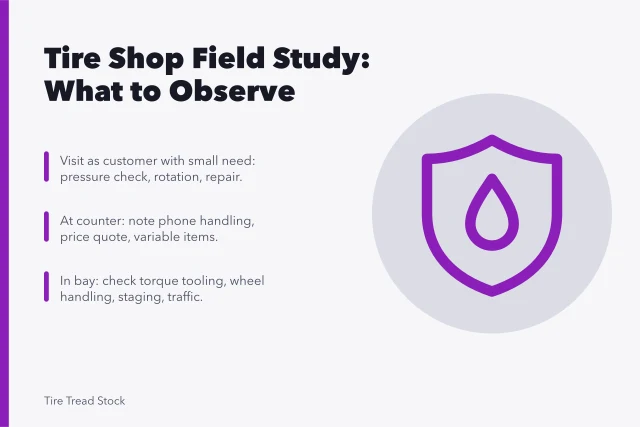
Whether you should be scoring areas at all, meaning whether the shop you already have is genuinely full, is the prior question worked through in the expansion and market guide. And the field-study method for reading the competitors in row nine, by visiting them rather than reading about them, is set out in the piece on studying other shops properly.
One safety note that affects rows one and two: fitment, sizing, load and speed markings, aging, registration and recall handling are set by the vehicle and tire manufacturers and covered in the federal tire safety guidance. What you counted on the road tells you the demand; what you may fit to a given vehicle is decided there.
Common questions
How long does scoring an area take?
Half a day per area, spread across two visits. The zoning and supply calls take another afternoon and should come first, because they can end the exercise.
Can I use a market report instead?
A report describes a county. Your customers come from a radius of a few miles, and no report is at that resolution. Use one for background if you like, but the counting is what produces the size list.
What if two areas score the same?
Break the tie on supply speed and on labor availability, in that order. Both determine how much capital and how much of your own time the site will consume.
Does an area with many competitors mean it is saturated?
Not necessarily. Row nine matters more than row eight: several shops that all refuse the same category of work is an opening, not a wall.
Should I score my existing area too?
Yes, as a baseline. It tells you what your own scores mean in practice, and it occasionally reveals that the area you already serve has openings you have not taken.