Guides
Tire shop plan: the parts worth your attention
A tire shop plan lives or dies on lift fitment, bay capacity and tire aging rules. Here is what each section must contain and what readers check.
What to take away
- A plan is read by people hunting for a reason to say no. Answer the obvious objection inside the section that raises it.
- Capacity is the section nobody writes and everybody judgeshow many mounted wheels can leave your bays in a week.
- Tire inventory turns on fitment. One wrong size family is dead stock, not slow stock.
- Every figure needs a source line. A number you cannot trace gets discounted to zero.
- Write down what you do not know yet. Readers trust a dated gap more than false completeness.
Who reads this and what they are looking for
Who reads this
| Reader | The question they are actually asking | What satisfies it |
|---|---|---|
| Lender | Can this cover payments in a slow February? | Cost structure, seasonal swing, and a downside case with named assumptions |
| Landlord | Will this tenant wreck the building or leave? | Waste tire storage and hauling, floor loading, hours, cash runway |
| Supplier on terms | Will this shop pay? | Volume estimate, ownership, order and payment routine |
| You, in month eight | What did I assume, and was I right? | Each assumption dated with a way to check it |
That last row gets skipped, and it is the one that pays. A plan with dated assumptions becomes a diagnostic tool you can argue with later.
Who reads the plan
Reader
- Lender
- Slow February coverage
- Landlord
- Building damage or exit
- Supplier
- Will the shop pay
- You, month eight
- Assumptions still valid
Question
- Lender
- Cost, season, downside
- Landlord
- Waste, floor, hours
- Supplier
- Volume, ownership, routine
- You, month eight
- Dated checks
What satisfies it
- Lender
- Landlord
- Supplier
- You, month eight
The nine sections your plan needs, in order
- What the shop sells.Not "tires." The mounted, balanced, torqued, road-ready wheel, plus rotation, seasonal changeover, flat repair and TPMS relearn. Name the jobs you refuse as clearly as the ones you take.
- Trade area.What you counted on the roads feeding the site, at what hour, on which days. Vehicle mix matters more here than in any other trade: a street of half-ton pickups stocks different sizes than a street of compacts.
- Capacity.Bays, lifts, technicians, and sellable minutes per week. This section turns a wish into a business.
- Inventory policy.Size families, depth per family, reorder trigger, aging rule, and the supplier routes that let you hold less.
- Pricing structure.How an installed job is quoted and what the quote includes. Give the logic, so a reader can test it against their own rent and labor.
- Staffing.Roles, who works unsupervised, and how the October to December rush is covered without carrying peak headcount all year.
- Compliance and waste.Permits, waste tire storage and hauling, safety program, and the written rule on what your shop will not repair.
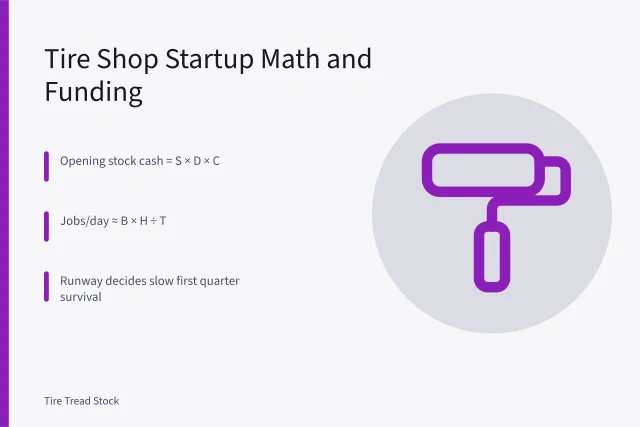
- Money.Opening cash, monthly fixed cost, the break-even point, and what happens if it arrives late. Work it once. Fixed cost near $14,000 a month against about $80 of gross profit per four-tire set breaks even at roughly 175 sets a month, which is eight sets a day over 22 working days. Treat both figures as illustration and swap in your own.
- Risks and unknowns.Written plainly. That is a strength in a plan, not a weakness.
The capacity section, written properly
Most plans carry a revenue line and no capacity line, which leaves the revenue unconstrained. Fix it with arithmetic in named variables instead of borrowed benchmarks.
Capacity arithmetic
- Bays you can staff
- Productive hours per bay
- Average bay time per job
- Jobs per day = B x H / T
- Times operating days per week
- Subtract comeback and waiting drag
Let B be the bays you can staff on a normal day. H is productive hours per bay. T is average bay time for a typical job in your mix. Sellable jobs per day is roughly B times H divided by T, times operating days per week.
Take three staffed bays, eight productive hours each, 0.75 hour of bay time for a four-tire set, and five operating days. Three bays times eight hours is 24 bay-hours a day. Divide by 0.75 and you get 32 sets a day, or 160 sets in a five-day week.
That number caps everything downstream. If your revenue projection needs a bigger number, the projection is wrong, not ambitious.
Then subtract honestly. A comeback eats bay time you already sold. Waiting on a special-order tire ties up a lift. A curbed wheel stops the job while somebody photographs it for the warranty file. Write down what you assume for that drag and revisit it after a month.
Which lifts and machines actually add sellable minutes is worked out in the guide to what the first bay needs.
The inventory section, written properly
This is where a tire plan separates from every other service trade, and where a generic template fails you.
Inventory policy in five steps
- State size families and counting dates
- Set depth per family with reasoning
- Name the reorder trigger and owner
- Set the DOT aging rule
- Log every miss and rewrite after a season
Sizing, load index and speed rating matching, aging, registration and recall handling belong to the tire and vehicle manufacturers, and to the current federal tire guidance. Cite that in the plan rather than asserting a rule from memory.
The DOT date code on the sidewall gives the week and year of manufacture. Most manufacturers put the inspection point at six years from that date, and a tire ten years past it should not be mounted. Write that as your shop rule: flag anything over six years at inspection and refuse to mount anything over ten.
Waste tire handling belongs in the same section. Storage limits, hauling contracts and any provincial recycling fee are set by your province or state. Name the authority and the schedule you checked.
California's tire fee, collected by CalRecycle, is $1.75 per new tire, and states with a program typically land between $1 and $4 per tire. Storage caps and hauling rules come with your state permit class, so the count that applies to your yard is the one to write down.
Sections that read as filler and should be cut
Sections that read as filler
- A mission statement that would fit any trade.
- A competitor table that names shops and never says what each refuses to do.
- A five-year projection past the point where you have a basis. Two years with dated assumptions beats five years of extrapolation.
- Any sentence about being customer-focused. Everyone writes it and nobody is judged on it.
Sources and authorities to cite
The opening sequence and the irreversible commitments sit in gating the four decisions you cannot undo.
The trade-area reasoning behind your demand section is in the market and startup guide. Staffing assumptions, especially peak-week coverage, come from building and training a bay crew. A second site belongs with the reasoning on where additional locations actually pay.
For the structure most lenders expect, the SBA's guide to planning a business is a reasonable frame.
The IRS page on setting up a new business covers the recordkeeping the money section depends on.
Tax treatment of any provincial recycling fee, and whether it flows through your books or your customer's, is a question for the Canada Revenue Agency or your provincial finance authority, not for this page.
Common questions
How long should the plan be?
Long enough that every section above has content, short enough that a lender reads all of it. Length is not the measure. A plan with a real capacity line and a real aging rule convinces at ten pages; a padded one at forty does not.
Do I need a plan if I am not borrowing?
The money reader is optional. The month-eight reader is not. Writing assumptions down with dates is the only way to learn later which ones were wrong, and that is worth the afternoon whether or not anyone finances you.
Should the plan include prices?
Include your pricing logic and your own worked numbers. Do not copy another shop's prices into your plan, because their rent, bay count and labor cost are not yours, and a borrowed price hides the fact that you have not run the calculation.
What if a section has no answer yet?
Write the section, mark it open, and name what would close it: a call to a distributor, a zoning check, a conversation with an insurer. An honest gap is a task. A gap papered over is a surprise waiting for month four.