Guides
3 rules for stock planning at tire shops in St. John's and Atlantic Canada
Tire tread stock planning for St. John's shops: marine freight lead times, salt slush damage, and supplier options through Halifax and local dealers.
What to take away
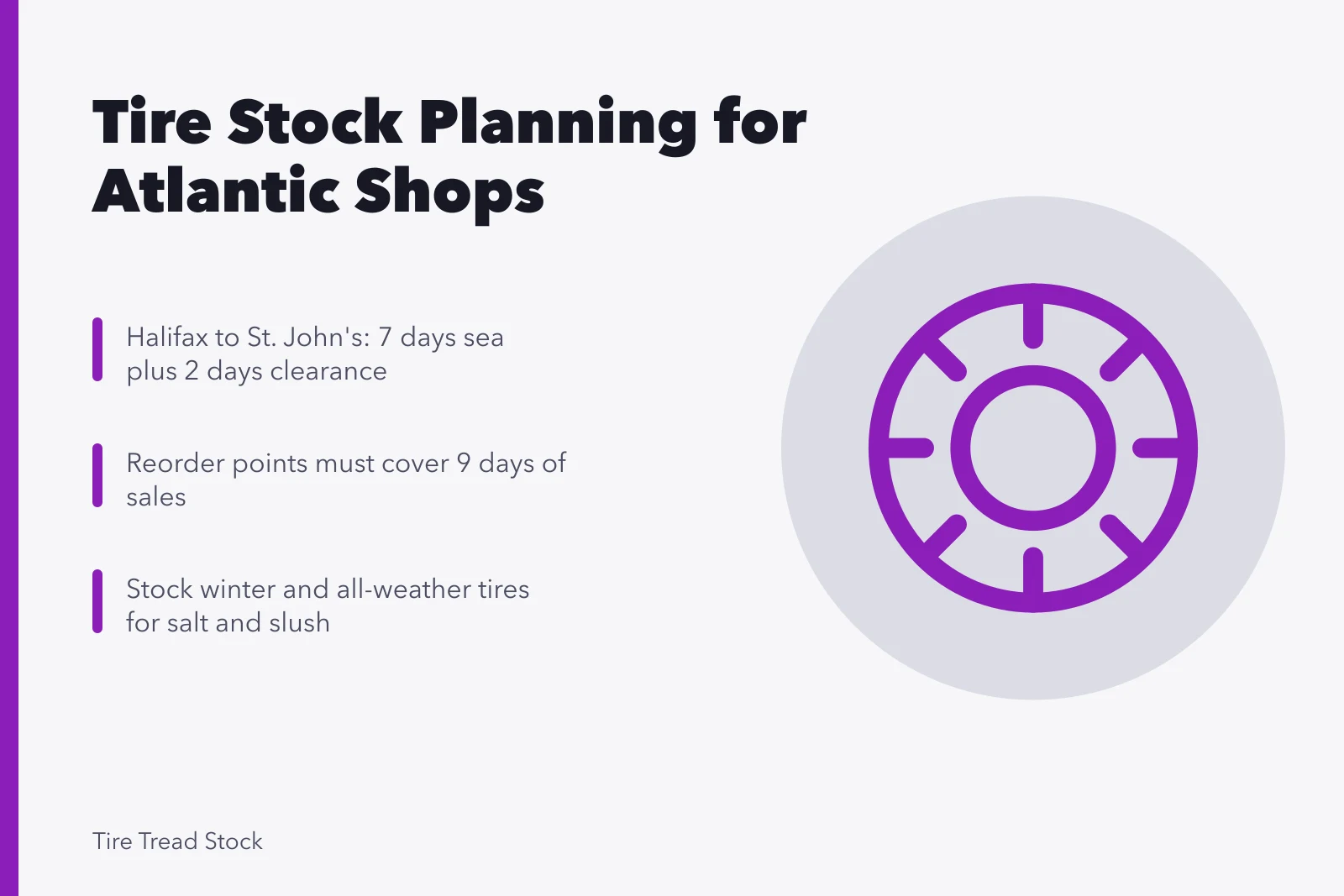
- A tire shipment from Halifax runs about seven days at sea plus two days to clear and reach your bay, so reorder points cover nine days of sales, not two.
- Salt and slush shorten tread life and corrode rims, so stock winter and all-weather compounds rather than deep-tread all-seasons alone.
- Two suppliers beat onea Halifax wholesaler for volume, a local St. John's dealer for same-day fills when a shipment is late.
- Set reorder points per size from your own 90-day sales velocity, then review them monthly.
- Every tire you sell must carry the markings set out in the Motor Vehicle Tire Safety Regulations before it goes on a shelf.
Rule one: plan around marine freight lead times into St. John's
St. John's is on an island, and most tires reach it by sea. A shipment from a Halifax wholesaler typically spends about seven days on the water, then a day or two clearing and moving to your shop.
Sea freight lead time to St. John's
- Day 0Order placed with Halifax supplier
- Days 1-7Tires on the water
- Days 8-9Clearing and moving to shop
- Day 9+Reorder point must sit above nine days
A mainland shop can reorder at two or three days of cover. You cannot. Your reorder point has to sit above nine days of sales.
Weather widens that gap. A winter storm can hold a vessel at the dock, and spring fog slows unloading. Order when stock is low and you will run dry mid-rush. Set the reorder point from lead time plus a buffer, and revisit it monthly against your own sales.
Statistics Canada publishes wholesale sales and inventories figures you can use as a regional yardstick. If your turns run slower than the Atlantic average, you are probably carrying slow movers you do not need.
Consolidate. One large shipment costs less per tire than three small ones and cuts the odds of a stockout. Book space with your Halifax supplier early. Some St. John's shops place the winter order in August to dodge the September crush.
Rule two: stock for salt and slush damage, not just snow
Newfoundland winters bring salt and slush, and they attack tires differently than dry snow does. Salt speeds up rubber degradation and corrodes rims. Slush hides potholes and road debris. A tire that looks sound can carry sidewall damage or tread separation after a few seasons of that.
That changes your buy. Stock winter tires whose compounds resist salt, plus all-weather tires for customers driving in mixed conditions. Studded tires are legal in Newfoundland from November to April, so keep a small quantity for the customers who ask.
Do not overbuy studded stock. Demand is narrow and the tires cannot be sold in summer.
Salt slush also shortens replacement cycles. A customer on salted roads may need new tires every three to four years rather than five. Keep steady depth in the sizes that fit compact cars and SUVs, which dominate the St. John's market.
Verify markings before anything goes on the shelf. The Motor Vehicle Tire Safety Regulations list what every tire sold in Canada must carry. A tire without them is not legal to sell here.
Rule three: build supplier options through Halifax and St. John's
One supplier is a single point of failure on an island. Run at least one Halifax wholesaler for volume and one or two local St. John's dealers for urgent fills. When a vessel is late, a local dealer keeps your bays moving.
Halifax wholesaler vs local St. John's dealer
Halifax wholesaler
- Best for
- Monthly volume
- Freight cost
- Lower per tire
- Delivery speed
- About nine days
- Brand range
- Consolidates several
- Risk
- Port congestion delays
Local St. John's dealer
- Best for
- Urgent fills
- Freight cost
- Higher per tire
- Delivery speed
- Same day
- Brand range
- Niche sizes faster
- Risk
- Limited deep stock
Halifax is the main mainland port for Newfoundland, and much of the Atlantic tire supply chain runs through it. A Halifax supplier can consolidate several brands into one shipment and cut freight per tire. Local dealers reach niche sizes faster and can deliver the same day.
Use both, on a schedule. Order regular stock from Halifax monthly. Call the local dealer for emergencies. You will pay more per tire, and it still beats turning a customer away.
Ask each supplier about their own lead times and their backup plan. A Halifax wholesaler sourcing from Ontario has a second ocean of delay behind it, so ask how they handle port congestion. A local dealer with deep stock may be the more reliable urgent option.
What Atlantic weather does to tread life and replacement cycles
Freeze-thaw cycles, salt spray and heavy snow wear tread faster here than steady prairie cold. A car parked outside takes extra UV and temperature swing, which degrades rubber further.
Tread life in St. John's often lands under the manufacturer's estimate. A tire rated for 60,000 kilometres may give 45,000 in this climate. Shorter cycles mean more tires per customer over the years, and a steadier replacement stream rather than a pure seasonal spike.
Statistics Canada publishes vehicle registration counts by province and census metropolitan area. Rising registrations in St. John's mean a bigger tire pool, and your stock should grow with it.
Retail trade data sharpens the forecast. The Retail Trade - ARCHIVED dataset shows sales trends by kind of business, which helps you spot seasonal patterns. Pair it with your own sales history.
Reorder points when the next shipment is a week at sea
Sea freight needs a different calculation than road freight. You need average daily sales, lead time in days, and a safety buffer.
reorder point = (average daily sales x lead time in days) + safety stock
For a St. John's shop, lead time is seven days at sea plus two days processing, so nine. Sell ten tires a day and your base reorder point is 90 tires. Safety stock, commonly 20 to 30 percent of lead-time demand, sits on top.
Set a sea-freight reorder point
- Calculate average daily sales per size over 90 days
- Confirm lead time in days with your supplier
- Multiply average daily sales by lead time
- Add safety stock at 20 to 30 percent
- Set reorder point and review monthly
| Tire category | Average daily sales | Lead time (days) | Base reorder point | Safety stock (25%) | Final reorder point |
|---|---|---|---|---|---|
| Winter tires (studded) | 2 | 9 | 18 | 5 | 23 |
| Winter tires (non-studded) | 6 | 9 | 54 | 14 | 68 |
| All-weather tires | 4 | 9 | 36 | 9 | 45 |
| All-season tires | 8 | 9 | 72 | 18 | 90 |
| Performance tires | 1 | 9 | 9 | 2 | 11 |
Substitute your own velocity figures. If your Halifax supplier is often late, raise safety stock. If a local dealer can fill gaps, you can trim it.
- Count physical stock weekly for the top 10 sizes.
- Compare counts to the point-of-sale system.
- Investigate discrepancies over 2 percent.
- Review reorder points monthly against actual sales.
- Adjust for seasonal demand changes.
- Log supplier lead times and delays.
- Share stock levels with the counter team.
Those steps keep reorder points honest. Our guide to tire shop kpis covers the monthly numbers worth watching.
Applying the three rules across Newfoundland and Labrador
The same rules hold in Corner Brook, Grand Falls-Windsor and Gander, though some of those shops get tires by truck from Halifax rather than by sea. Long lead times, salt slush, and more than one supplier still apply.
Labrador runs a longer, colder winter, so weight the mix toward winter tires and away from all-seasons. Eastern Newfoundland deals with fog and salt spray, so favor tires that resist corrosion. Central Newfoundland roads are rougher, which argues for stronger sidewalls.
A second location changes the math. Different region, different mix, different lead time. Our guide to tire shop expansion works through the logistics.
Stock planning is also a cash decision. Too much stock ties up money; too little loses sales. Our article on tire shop profit margin shows where the two meet.
For the wider picture, see our tire shop operations guide. To time deliveries against bay capacity, read how to schedule tire shop jobs without delays.
Common questions
How often should I review reorder points?
Monthly, and again whenever you change suppliers or see demand shift. The spring and fall seasonal transitions are the natural checkpoints.
What if my Halifax supplier is out of stock?
Keep a local St. John's dealer as backup. A higher price per tire still beats an idle bay. A second Halifax wholesaler is worth having on file too.
Do I need to stock studded tires?
Yes, in small quantity. They are legal in Newfoundland from November to April, but demand is narrow, so carry popular compact and SUV sizes only.
How does salt slush damage affect warranty claims?
Salt and slush can cause sidewall cracking and tread separation that standard warranties may not cover. Photograph the tire and the vehicle's condition, and document what you told the customer about care.