Guides
Quebec's winter tire law and what it means for shop stock in Montreal
Quebec requires winter tires from December 1 to March 15, so Montreal shops build tread stock, bay time and French counter scripts around the November rush.
What to take away
- Quebec's Highway Safety Code requires winter tires on registered passenger vehicles from December 1 to March 15.
- Montreal's first lasting snow usually lands in mid to late November, and appointment books fill in the last two weeks of October.
- The three-peak mountain snowflake symbol is the marking that satisfies the law. An M+S stamp on its own does not.
- Stock ordered in September is what sells in November, because suppliers allocate the fastest-moving 16 and 17 inch sizes first.
- A tread depth reading in millimetres, written down with the DOT code and the technician's name, is the shop's defence when a customer returns after a January collision.
The dates that govern Montreal tire stock
The legal window is fixed: December 1 to March 15, every year, for passenger vehicles registered in Quebec. The Societe de l'assurance automobile du Quebec publishes the dates, the permitted tires and the narrow list of exemptions.
Montreal winter tire calendar
- Aug-SepOrder winter stock from suppliers
- Nov 1Demand surge begins for swaps
- Mid-late NovFirst lasting snow arrives
- Dec 1Legal winter tire deadline
- Mar 15Legal window ends
For a Montreal shop, the date that moves inventory is November 1. Drivers want the swap before the first snow, and the first snow that stays on the ground usually arrives in mid to late November. Demand in those four weeks runs several times the January baseline.
That surge decides tire tread stock for the whole year. A shop that orders its common sizes in November is bidding for what is left after the September buyers have been filled.
Storage competes with stock for the same square footage. Montreal shops hold customers' summer sets through the winter, and those racks occupy floor space that would otherwise carry sellable inventory. A storage plan is a stock plan.
Why the Montreal calendar is tighter than the law
The law allows until December 1. Customers do not. By November 10, most Montreal shops are booking into the first week of December, which is already at the legal edge.
A shop that treats December 1 as its deadline loses the customers who wanted November service. They call the next shop on the list, and they usually stay there for spring and summer work too.
What SAAQ enforcement means at the counter
The SAAQ enforces the requirement through roadside checks and, in some cases, after a collision. A vehicle without compliant winter tires during the window can bring a fine and demerit points to the driver. The shop does not enforce the rule, but the shop is where most drivers first hear it.
Counter answers on SAAQ rules
- State the December 1 start date
- State the March 15 end date
- All four wheels must be fitted
- Rule applies to Quebec-registered vehicles
- Visitors on short stays generally exempt
- Keep SAAQ page at the counter
Counter staff should be able to state three things without looking them up: the start date, the end date, and the fact that all four wheels must be fitted. Telling a customer that two winter tires on the drive axle are enough is wrong in Quebec and creates a liability problem for the shop.
The rule applies to vehicles registered in Quebec. Visitors from Ontario or the United States on a short stay are generally not required to fit winter tires, and that question comes up daily in a city with out-of-province plates on every block.
Keep the SAAQ page at the counter, printed or bookmarked, so every employee gives the same answer. Two different answers on the same day read as carelessness, and customers notice.
What to say when a customer pushes back
Some customers argue that their all-seasons have deep tread, so they are fine. The answer is that Quebec requires tires marked for winter use. Tread depth is not the test; the sidewall marking is, and the SAAQ lists which markings qualify.
Others ask whether they can wait for the first snowfall. They can wait until December 1. The shop may not have an appointment by then. That answer fills November slots better than any advertisement.
Which tires qualify, and which do not
A tire qualifies in Quebec when it carries the required winter marking. In practice that means the three-peak mountain snowflake symbol. Tires stamped M+S alone have not satisfied the Quebec requirement since the rule was tightened, so staff should never present them as compliant.
Sidewall markings at the counter
Marking
- Three-peak mountain snowflake
- Meets Quebec requirement
- M+S only
- Not sufficient in Quebec
- Stud symbol or studs
- Legal only in SAAQ period
- DOT code
- Federal safety marking
Montreal counter meaning
- Three-peak mountain snowflake
- M+S only
- Stud symbol or studs
- DOT code
Studded tires are legal in Quebec, but only from October 15 to May 1, the period the SAAQ sets. Outside it, studs are not allowed on Quebec roads. Ask about studs at the counter, because most customers do not know the dates.
Every winter tire sold in Montreal must also meet federal requirements. The Motor Vehicle Tire Safety Regulations set the markings and performance rules for tires sold in Canada, and staff should be able to find those markings on the sidewall.
Exemptions exist and they are narrow, covering certain emergency vehicles and vehicles that cannot physically take winter tires. Do not stretch them for a customer who simply does not want to buy.
The markings to check on the sidewall
Marking / What it means at a Montreal counter
- Three-peak mountain snowflake
- Meets the Quebec winter tire requirement
- M+S only
- Not sufficient for the Quebec requirement
- Stud symbol or studs fitted
- Legal only from October 15 to May 1
- DOT code
- Federal safety marking, with production week and year
- Load and speed index
- Must match or exceed the vehicle specification
A tire that fails the marking check is not a winter tire under the law, however aggressive the tread looks. Check the sidewall before the tire goes on the balancer, not after.
Planning stock for the November rush
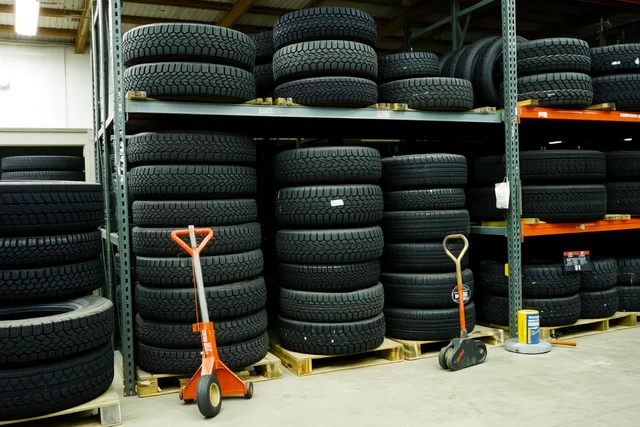
Winter stock planning in Montreal starts in August and September. Suppliers fill orders in the sequence they arrive, and the popular sizes are allocated first. A shop ordering in October competes for leftovers.
Build the order from last winter's sales, not from a generic catalogue list. Rank the top twenty sizes by volume, add fitments for new vehicles you saw in the bay this year, and hold a buffer on the sizes that always run short. The buffer usually belongs in 16 and 17 inch passenger sizes, not in truck sizes.
Then decide how much to hold and how much to order on demand. Overbuying ties up cash until spring. Underbuying means turning away work in the busiest month of the year. Most Montreal shops cover the November rush from stock and use supplier orders for January and February replacements.
Labour belongs in the same plan. A shop that can sell a set of tires but cannot install it the same week has a scheduling problem, not a stock problem. A method to schedule tire shop jobs by job type keeps the November book realistic.
A stock plan in steps
Building the November stock order
- Pull last winter's sales by size and rank
- Add sizes for new vehicle models
- Set target levels for top twenty sizes
- Buffer fastest movers in 16 and 17 inch
- Place main order in September
- Use supplier orders for January and February
A rush checklist for the last week of October
- Count the top twenty sizes against the target level.
- Print the SAAQ dates and permitted markings for the counter.
- Confirm French signage and French documents are in place.
- Confirm appointment capacity for the first three weeks of November.
- Set the winter package price, including installation and storage.
- Brief staff on the exemptions and on what not to promise.
- Clear and label the storage area for customer sets.
Bilingual service and signage at a Quebec counter
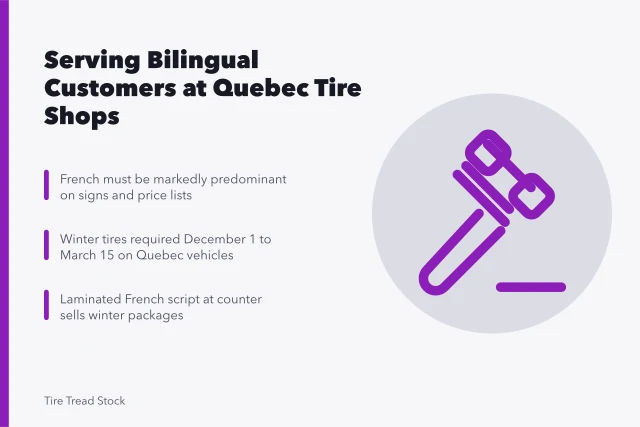
Quebec's language rules cover commercial services, and a Montreal tire shop serves customers in French and English every day. Customers have the right to be served in French, and signs, posters and standard documents must be in French.
French documents to have ready
- Invoices available in French
- Estimates available in French
- Work orders available in French
- Warranty documents available in French
- Storage agreements available in French
- French version offered, English optional
Most Montreal shops already operate bilingually. The exposure is not bilingual service; it is French signage that is missing, incomplete or bolted on late. Price lists, service menus and warranty terms should exist in French, with English available alongside.
Staffing should match the neighbourhood. A shop in a French-speaking area needs French-first staff on the counter. A shop near an anglophone or allophone customer base still needs French service available, because the right to service in French does not depend on the customer's first language.
Training matters here. A new employee who can explain a tire size in English but not in French hands the phone to someone else, and that costs minutes in November. A tire shop equipment review is a good moment to build counter scripts in both languages, because the same questions come up at the balancer and at the desk.
Documents to have in French
Invoices, estimates, work orders, warranty documents and storage agreements should all be available in French. The customer may choose English, but the French version has to exist and be offered.
One test settles it: if a French-speaking customer cannot complete the transaction in French, the shop has a compliance problem. Run that test once in September, not during the rush.
Tread depth checks and records through the winter
Winter tires wear faster than most customers expect, and Montreal's freeze-thaw cycles and road salt do not help. A tire that passed inspection in November can be below a safe depth by February. Measure tread depth at every visit, not only at installation.
For winter tires the practical threshold is higher than the legal minimum for summer tires. Grip on ice and packed snow falls off well before the tire is legally worn out. Record the measurement in millimetres and explain what it means for the customer's driving.
Records protect the shop. If a customer has a collision in January and claims the shop fitted unsafe tires, the inspection record is the defence. It should show the date, the tread depth, the tire markings, the installation and the customer's acknowledgement.
Ontario's rules give a useful comparison for shops serving customers from both provinces. The e-Laws | Ontario.ca regulation sets out inspection requirements that differ from Quebec's, and knowing the difference helps when a customer crosses the border regularly.
What a winter inspection record should contain
A usable record carries the vehicle identification number, the odometer reading, the tire size, the DOT code and the tread depth at each wheel. Add the date and the technician's name. A photo of the tread with a gauge in frame settles most disputes quickly.
Keep records for the life of the tire and beyond, in case of a claim. Digital records are easier to search, but a paper file that actually gets filled out beats a system nobody uses.
Comparing inspection practice across provinces
Winter tire rule
- Quebec
- Mandatory December 1 to March 15
- Ontario
- No province-wide mandate
- Alberta
- No province-wide mandate
- British Columbia
- Seasonal rules on some routes
- Manitoba
- No province-wide mandate
What it means for the shop
- Quebec
- Record tread depth and markings at installation
- Ontario
- Tread depth rules still apply for safety
- Alberta
- Insurers may ask for proof of winter fitment
- British Columbia
- Signs and route-specific requirements
- Manitoba
- Winter conditions drive voluntary fitment
Quebec is unusual in Canada for having a hard date range, which is why Montreal shops plan differently from shops in Toronto or Calgary. The law creates a predictable spike, and a predictable spike can be planned for.
Where the rest of the operation fits
The winter season tests a shop's systems. Stock, scheduling and records come under pressure in the same four weeks. The tire shop operations guide is worth revisiting in September, before the rush exposes the gaps.
Pricing is part of the stock plan. A winter package bundles tires, installation, balancing and storage, and every element carries a cost. The Finance, income and other taxes pages are the reference for how Quebec taxes apply.
New owners sometimes treat the winter rush as a sales event. It is better understood as an operational event. The tire shop compliance checklist covers the items that must be in place before the first snow.
Common questions
When do winter tires have to be on in Quebec?
From December 1 to March 15, under the Highway Safety Code, for passenger vehicles registered in Quebec.
Are M+S tires enough for the Quebec law?
No. The tire must carry the required winter marking, which in practice means the three-peak mountain snowflake symbol. An M+S stamp alone does not meet the requirement.
Are studded tires legal in Montreal?
Yes, but only from October 15 to May 1, the period the SAAQ sets. Outside that period, studded tires are not allowed on Quebec roads, and the dates are worth posting at the counter.
When should a Montreal shop order winter stock?
Place the main order in September, with a second order in mid-November to refill the fastest-moving sizes. Waiting until November means competing for stock that suppliers have already allocated.